I don’t understand publishers’ economics. A coffee-table book on Bollywood is priced Rs.1995. Sounds like Bata shoes price tab, doesn’t it, – A pair there is marked Rs.999, never a thousand? I know the coffee-table genre are bought for drawing-room furnishing, rather than for reading pleasure.
The book is titled – Lights, Camera, Masala: Making Movies in Mumbai – text by Naman Ramachandran with photos, by Sheena Sippy. It is unputdownable for a good half hour, says The Hindu Literary Review columnist Pradeep Sebastian. He sounds a note of caution for those who may think of buying it. You look at the marked price, which makes you think again. So, what do you do? “Settle in more comfortably to browse through the book for another half hour before you put it down and leave the store”, writes Mr Sebastian. Lights, Camera, Masala…...is published by India Book House (IBH)
Its poor publishing cousin, National Book Trust (NBT), offers K S Duggal’s autobiography – Whom To Tell My Tale – for Rs.65 (yes, I have checked the price list). Reviewer Anita Joshua says the book may get ignored for its shoddy editing. I can think of another reason – its price. We are so conditioned to seeing a three-figure price tag even on pedestrian stuff that we instinctively reject, thinking that a book priced so low as Rs.65 can’t be good. Whatever the reason, ignoring Duggal’s book, says the reviewer, would be ‘akin to sending an innocent man to the gallows’. It would not take long for even a reader unfamiliar with Duggal’s writings to realize the power of his word.
Cost of a book is in no way related to the quality of its content. Maybe I shouldn’t be comparing NBT books with those of IBH or other private publishers. Their economics are different. National Book Trust, being a state-run outfit, can afford to ignore economics. But then we credit many in the publishing business with motives that are not primarily profit-driven. Ask publishers, and they say they lose money on most of their titles. I suppose it is the economy of cross-subsidy that keeps them afloat – pricing high-selling books high enough to ‘carry’ other titles. At the same time they don’t mark the price of a book any lower simply because it doesn’t sell.
Showing posts with label Books. Show all posts
Showing posts with label Books. Show all posts
March 6, 2007


February 4, 2007
India will overcome, says who?
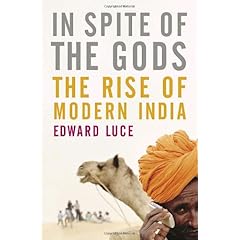
Says Edward Luce, who has been India correspondent of The Financial Times, London. He writes about “the strange rise of modern India” in his book, titled, In Spite of the Gods. It won’t be enjoyed, reckons The New York Times review, by Indian diplomats, academics, Hindu nationalists and makers of cow-dung anti-dandruff shampoo. “Most others, I suspect, will relish”, says the reviewer Ben Macintyre.
Nicely put, Ben. My suspicion is that many of the academics and diplomats who read this sentence would want to read the book, if only to repudiate it; and the others would be inclined to buy it to see what is there in it that would not please Hindu nationalists. And I would want to figure out why Ben, the book reviewer, has excluded the shampoo makers.
The author of this book cautions that the expectation of success has infected India’s privileged classes with “a premature spirit of triumphalism” that could prove self-defeating, a case of counting chickens before they are eggs. “India is not on an autopilot to greatness”, says NYT review quoting the author, “it would take an incompetent pilot to crash the plane”.
The Edward Luce prescription:Improve education, strengthen liberal democracy, develop a coherent energy strategy and radically revise the transport system before the country’s car population swells from 40 million today to an expected 200 million by 2030 and brings the entire country to a chocking standstill.
My question: Can we accomplish all this? Sure, all it takes would be a miracle mindset-change in our people and policy-makers alike.
January 15, 2007
A touching tale of an untouchable
 Vinod George Joseph’s Hitchhiker is no ordinary Joe’s story. It’s an untouchablity tale told, touchingly, by a lawyer with literary aspirations. As a debut book Hitchhiker has been much reviewed; and foreword-ed by Anita Pratap (remember seeing her on CNN?). A word about her foreword. In her incarnation as book publisher Ms Pratap takes a swipe at her own (media) tribe. She says that among the many manuscripts she gets are some from outstanding journalists who can’t write.
Their offerings are ‘muddled and fuddled, showing neither talent nor promise’. Hitchhiker is not by a journalist. And Ms Pratap found it unputdownable – ‘grips you with its effortless prose; a language that is simple, sparing and unpretentious – almost Hemingway-like in its leanness’ (Ms Pratap lost me there). Such hype pre-sets reader expectations. Mr Joseph is however modest in his expectations from readers. As Hitchhiker author put it in his preface, “my only request to readers is that they keep an open mind until the end of the novel; and, hopefully, even after that”.
A message the author seeks to convey is that untouchability is an issue that we can’t wish away. It is like a jelly. You try to curb or crush it through law, it swells up in a non-cognizable form. Untouchablity is about social attitude; about our mentality. And you can’t legislate against a mentality. The mentality , of not just the perpetrators, but of many victims of untouchability as well. Their plight is brought out in touching details by the author in his account of a rape scene (Page 72). A woman, condemned to witness her daughter being gang-raped, doesn’t complain. She merely stands there, weeping.
Finally, she fell to her feet and started tugging at the legs of the men who were holding and raping her daughter. She didn’t scream; didn’t try to pick up a stone and hit the men on their heads. Just crying and begging softly so that no one else would hear of her daughter’s disgrace…… When Karuppamma’s father arrived, it was all over. He took in the scene and realized what must have happened….As he stood there in shock Solaimani (employer of the victim family) gave the man his wages, added another ten rupees, and told him, ‘the extra ten is for your daughter; take good care of her; we’ll need her again’.
The last ten words represent the last word on sheer temerity, no matter what the statute book might say on untouchablity. Speaking of words, I could not help notice that the forgoing paragraph could have done with some editing. The paragraph of 100 odd words has 15 too many. Having been a newspaper sub-editor I tend to view everything I read with an editorial mind.
The author, with help from the publisher’s editor, could have tightened the text, reduced it by 50 odd pages, without sacrficing style, sense, or substance. As it is, I find the book bulky and oversized. It hasn’t been designed for bedside reading. And I have this bad habit of doing most reading in bed.
Hitchhiker, Vinod George Joseph, 385 pages; Rs.350. Published by Books for Change, Bangalore. E-mail – bfc@actionaidindia.org.in ; shoba.ram@actionaid.org .
Reviews: Titles – Books for Change
Desicritics
Vatsanin Kirukkals
Blogpourri
Desijournal
Hindustan Times
Dabbler
Subscribe to:
Posts (Atom)
