I wish other public and private sector agencies, in other places, emulate the Coffee Board of India, in sponsoring a fun-filled day out for the orphanage and other socially disadvantaged children everywhere. The coffee board is reported to have organized a spin around town on a topless double-decker for some 60 children, all below 10, of Anatha Sishu Nivasa, Basavanagudi, Bangalore.
Thoughtfully, the trip organizers put a Santa Claus on board to hand out balloons, toffee and other Christmas goodies to the children, who rarely, if ever, get a chance to stir out of their institution. Wouldn’t it be nice if such children could find someone to take them out now and then, to the local zoo, to picnic at a park or to a movie?
Finding sponsors, and volunteers to escort the children, may not be difficult. The tough part, I reckon, is convincing the authorities of orphanages and other charity institutions to allow their children to be taken out periodically. They tend to view it as safety and security issue; and they are generally unable or unwilling to take the responsibility. In many cases, it entails permission from the governing board, which has its share of members who are not amenable to fresh ideas.
The governing body of an orphanage or charity institution is a mixed bag. A typical managing committee is precedent-driven. Stock reaction to any fresh idea is, ‘have we done any such thing before ?’ A negativist would think of risks, and little else, of trying out anything new. What if something were to go wrong?And then there are, what I call, ‘can’t-doers’ who can trot out six reasons why what you suggest cannot be done. I have heard someone objecting to children’s outings, for fun and exposure, because they could ‘get used to them’.
December 27, 2006


December 26, 2006
Mysore Oriya initiative in temple restoration
 A view of the Cauvery from the time-ravaged temple.
 I was skeptical when I first learnt of the Orissa Association Mysore (OAM) temple restoration project. It is a tough task, taking on a 11th century temple that remained neglected for the last 400 years. The initial cost estimate was Rs.12 lakhs. Could the Oriya association mobilize the resources? That an association, with less then a hundred member, could even consider such a venture spoke of their think-big mindset. Or was it naivety? I shared my misgivings with OAM president Mr Dilip Kumar Misra. This was a year ago.
When I met Mr Misra and another committee member Mr Ghanshyam Pradhan recently they said the project cost had risen to Rs.30 lakhs, but added that the pace of progress was encouraging. A Kalakarshana ceremony (a ritual marking the start of inner temple restoration work) was performed at Belagola village, off the Mysore-KRS Road, this October. Mr Misra expected the work to be completed in two years. Details of the project and also the status of progress made so far can be accessed at http://www.mysoreoriya.org/.
To a question about fund-raising Mr Misra had a four-word response - “I believe in miracles”. The progress made till now, from the day when the idea occurred to him and a few others, on the Ganesh idol immersion day in 2003, was in itself the result of a series of minor miracles. “It is as if we are being driven by a divine force,” said Mr Misra, adding that there was no room for pessimism in this scheme of things.
It took the Oriya association well over one year to get official clearance. There was so much of paper work that, after a point, Mr.Misra said he simply signed on, without even looking into the papers. He didn’t want permission to be denied for want of a single signature. Most form-fillings were, anyway, a formality and a bureaucratic requirement. Mr Misra was not complaining. Merely stating what it took to get the government go-ahead for the temple restoration project.
December 25, 2006
A run on the highway eateries
I happened to be on the road, from Mysore to Bangalore on the day before Christmas. And I found our favourite breakfast joint run by MTR packed, with a spill-over of customers waiting for table. We moved on to Kamat, further down the highway, only to find a much bigger crowd. Our taxi-driver suggested a self-service eatery that served special idli at Bidadi. Same story there as well. We had to make it to Bangalore without breakfast.
On our return from Bangalore, at lunch time on Christmas Day, the situation was the same at Kamat, though we managed to get a table at the MTR. But then the lunch hour rush proved too much for the catering staff. The waiter took much longer to serve, the puri we ordered came with chutney and plain dal, instead of the customary kurma or masala. And then we had to hang around for 15 minutes at the payment counter, because even the manager-cum-cashier was drafted to serve tables to cope with a run on the restaurant.
In contrast to the chaos at MTR, the Coffee Day next door was relatively empty. Maybe our middle-class clientele isn’t yet ready (or pretentious enough) for the Starbucks culture. Maybe Coffee Day, unmindful of its scrupulously nurtured image, ought to add to its menu items such as thali meals and idli-vada breakfast.
We could do with one or two more strategically located middle-class eateries on the Bangalore-Mysore highway. The middle-class goes for brand image. Several small eating houses, and so-called dabhas along the highway don't seem to attract the car-borne middle-class that goes for the Kamats and the MTR. Mysore’s own GTR, Ramyas or Maheshprasad, I reckon, would do well, if they set up shop on the highway.
On our return from Bangalore, at lunch time on Christmas Day, the situation was the same at Kamat, though we managed to get a table at the MTR. But then the lunch hour rush proved too much for the catering staff. The waiter took much longer to serve, the puri we ordered came with chutney and plain dal, instead of the customary kurma or masala. And then we had to hang around for 15 minutes at the payment counter, because even the manager-cum-cashier was drafted to serve tables to cope with a run on the restaurant.
In contrast to the chaos at MTR, the Coffee Day next door was relatively empty. Maybe our middle-class clientele isn’t yet ready (or pretentious enough) for the Starbucks culture. Maybe Coffee Day, unmindful of its scrupulously nurtured image, ought to add to its menu items such as thali meals and idli-vada breakfast.
We could do with one or two more strategically located middle-class eateries on the Bangalore-Mysore highway. The middle-class goes for brand image. Several small eating houses, and so-called dabhas along the highway don't seem to attract the car-borne middle-class that goes for the Kamats and the MTR. Mysore’s own GTR, Ramyas or Maheshprasad, I reckon, would do well, if they set up shop on the highway.
December 22, 2006
Pranoy (NDTV) Roy hogs talk time
I have a problem with Pranoy Roy hosting a chat-show. He tends to hog the talk time. In NDTV Q & A (Dec.22), featuring Inforsys Narayanamurthy, a large and very informed studio audience could get no more than two questions. The 30-minute show, of which three or more minutes were lost to commercial break, was dominated by the host, Mr Roy. Who isn’t fond of hearing his own voice? But I wish Mr Roy had let his guest finish his thoughts or have his say without interruption. Before N M finished answering a question P R came up with a fresh one. I am sure TVwalahs have their reason; time constraints. NDTV programme producer could turn around and say, ‘we haven’t the whole day, mate’.
I recall, during the Emergency, Indira Gandhi (so feared at home) was once cut off in mid-sentence by an interviewer of an American news channel, saying, 'Thank you, Madam Prime Minister, that's all we have time for'.
During the NDTV show there were moments when we had Pranoy Roy butting in with his one-liner. As Narayana Murthy articulated his thoughts on giving away much of his vast wealth, by setting up a corpus, the show host came up with a quip, ‘what, if your son were to hear this’, or something to that effect. I wonder if Mr Narayana Murthy would have put up with such impolite intteruption, had it come from a lowly newspaper reporter during a press conference in his native Mysore. But then N M managed to have the last word. When the show host invited questions from the audience - ‘the suited gentleman there, on the third row’ - Mr Murthy put Mr Roy down, saying, he (Narayana Murthy) had set a ground rule on Q & A.
Which was, a woman and a gentleman would take turns in asking him questions, and a lady in the audience would make the start. And the lady asked why N M wouldn’t enter politics - ‘we would like to see you in the cabinet’. When Mr Narayana Murthy reiterated that he had no desire to enter politics, we had Mr Roy saying, rather pointlessly, that Mr Murthy may not want to, but it was the desire of society (that he should be in the cabinet).
To be fair to Mr Roy, the NDTV show managed to bring out the man behind India’s best known IT corporate face. In his young days (in Mysore, presumably) Mr Murthy used to make daily visits to the railway station, and part with some small change by way of alms. For him, making money was less of a priority than seeking respect for his company in the corporate world - ‘coming from the middle-class, respect means a lot more to me’.
Now that he got tons of it, what did he spend his money on? Gadgets, and books. He said (if I heard him right) he bought books worth Rs.20,000 a month.
P R to N M: What is your one big ambition? Having asked him, Mr Roy wouldn’t allow Infosys Murthy time enough to marshal his thoughts. We heard him saying that his son kept nagging Mr Murthy - ‘you still haven’t written it down what you want to do in the next five years’. Viewers were left wondering what it meant. Was he being pushed by his son to do a book? Was a Murthy memoirs in the works? Mr Roy wouldn’t let him finish his thoughts before he sprang the next question, on Mr Murthy’s business ethics.
Mr Narayana Murthy justified the early Infosys policy of giving company stocks to all its employees, which has made very many employees filthy rich. The Infosys founder observed it was the first such move by any Indian company, and the largest experiment in democratization of wealth. This resulted in some employees leaving Infosys to set up their own companies. Mr Murthy referred to an ex-Infosys man getting into developing a golf course.
I recall, during the Emergency, Indira Gandhi (so feared at home) was once cut off in mid-sentence by an interviewer of an American news channel, saying, 'Thank you, Madam Prime Minister, that's all we have time for'.
During the NDTV show there were moments when we had Pranoy Roy butting in with his one-liner. As Narayana Murthy articulated his thoughts on giving away much of his vast wealth, by setting up a corpus, the show host came up with a quip, ‘what, if your son were to hear this’, or something to that effect. I wonder if Mr Narayana Murthy would have put up with such impolite intteruption, had it come from a lowly newspaper reporter during a press conference in his native Mysore. But then N M managed to have the last word. When the show host invited questions from the audience - ‘the suited gentleman there, on the third row’ - Mr Murthy put Mr Roy down, saying, he (Narayana Murthy) had set a ground rule on Q & A.
Which was, a woman and a gentleman would take turns in asking him questions, and a lady in the audience would make the start. And the lady asked why N M wouldn’t enter politics - ‘we would like to see you in the cabinet’. When Mr Narayana Murthy reiterated that he had no desire to enter politics, we had Mr Roy saying, rather pointlessly, that Mr Murthy may not want to, but it was the desire of society (that he should be in the cabinet).
To be fair to Mr Roy, the NDTV show managed to bring out the man behind India’s best known IT corporate face. In his young days (in Mysore, presumably) Mr Murthy used to make daily visits to the railway station, and part with some small change by way of alms. For him, making money was less of a priority than seeking respect for his company in the corporate world - ‘coming from the middle-class, respect means a lot more to me’.
Now that he got tons of it, what did he spend his money on? Gadgets, and books. He said (if I heard him right) he bought books worth Rs.20,000 a month.
P R to N M: What is your one big ambition? Having asked him, Mr Roy wouldn’t allow Infosys Murthy time enough to marshal his thoughts. We heard him saying that his son kept nagging Mr Murthy - ‘you still haven’t written it down what you want to do in the next five years’. Viewers were left wondering what it meant. Was he being pushed by his son to do a book? Was a Murthy memoirs in the works? Mr Roy wouldn’t let him finish his thoughts before he sprang the next question, on Mr Murthy’s business ethics.
Mr Narayana Murthy justified the early Infosys policy of giving company stocks to all its employees, which has made very many employees filthy rich. The Infosys founder observed it was the first such move by any Indian company, and the largest experiment in democratization of wealth. This resulted in some employees leaving Infosys to set up their own companies. Mr Murthy referred to an ex-Infosys man getting into developing a golf course.
December 19, 2006
SSLC through Sunday school
US based scientist, Mr Krishnamurthy, who passed his SSLC from a Nanjangud municipal school, runs SSLC (Surya Shloka Learning Center) course at his home (Chandlers ?) on Sundays for NRI children. The Krishnamurthy couple are known in the Phoenix, Ariz., Indian social circle; and have been, should I say, widely known Kannada Sangha activists in America's sixth largest city. A Bombay IITan, with over 100 published papers to his credit, Krishnamurthy (who, we declare with pride, is related to my wife) has been running SSLC for the last seven years, along with wife Girija, who, I believe, teaches at a school for tribal Indians in Arizona. An alumnus of Mysore University Girija is the daughter of a well known Mysorean, Vakil Srikantaiah.
Referring to his passion for educating ABCDs (America-born/brought-up-confused-desis) on our culture and values, Krish e-mailed the other day, " Surya Shloka Learning Center meets every Sunday from 11 AM to 12 noon. It is somewhat like a Balvihar with the objective of educating children, growing up in the US, about Hinduism, our culture and traditions. Some 20 kids in a wide-ranged 2-16 age group attend our classes regularly. Many parents (and, sometimes, grandparents) sit in with the kids and they tell me that it has been a learning experience for them as well. Of course, I enjoy explaining the Sanskrit verses and telling stories. It's lot of fun".
Referring to his passion for educating ABCDs (America-born/brought-up-confused-desis) on our culture and values, Krish e-mailed the other day, " Surya Shloka Learning Center meets every Sunday from 11 AM to 12 noon. It is somewhat like a Balvihar with the objective of educating children, growing up in the US, about Hinduism, our culture and traditions. Some 20 kids in a wide-ranged 2-16 age group attend our classes regularly. Many parents (and, sometimes, grandparents) sit in with the kids and they tell me that it has been a learning experience for them as well. Of course, I enjoy explaining the Sanskrit verses and telling stories. It's lot of fun".
December 16, 2006
It's my turn to change diapers
I missed the TV soap but its title - Saas bhi kabhi bahu thi - set me working on this piece, of which the theme is - Bahu meri bani beti. To those who find my use of desi words irksome I submit that words such as daughter and daughter-in-law, in plain English, sound mundane, and they do not convey the sense of distinction between a bahu and beti . Both are four-letter words. But beti is an endearing term; bahu , somewhat lower down on saas-sasur's endearment scale.
A bahu usually comes to in-laws place with pre-conceived notions, some social baggage; and she feels stifled by the terms of reverence she is constrained to adopt while staying with her in-laws. This needn't be so. The month my bahu, beta and our potha , Siddarth, spent with us in Mysore recently was a learning experience. For a start, I discovered that there are at least four versions of 'Ring Around Rosie'. This one, said to be mom of all ring-around nursery rhymes, predates Chaucer's Canterbury Tales. I couldn't figure out my bahu's favoured version, for she sing-songs in an accent I have problem grasping. Never mind the words. They all sound the same to our year-old Siddarth, so long as the rest of us are there to dance to his tune.
I can't say my daughter-in-law Meera fits into the traditional mould of a bahu. For one thing, she is America-born. And, as such, she is free from hang-ups of a home-grown daughter-in-law, who is portrayed in movies as some one who, in the presence of elders and strangers, hides her face behind gunghat ; someone who doesn't share dinner table with saas-sasur, but serves them instead, before she takes food. Far from wearing gunghat, Meera prefers to move about the house in T-shirt and slacks, which, I suspect, come from my son's wardrobe. Such informality is a kind of social licence to which only a beti would be entitled in standard Indian households.
But then neither my wife nor I has ever been saas-sasur to Meera. And we don't have a biological daughter. That Meera continues to address us aunty-uncle, as she did before her wedding, is not lost on some of our tradition-bound relations. I wouldn't have her address us any differently. If Meera were to call us Appa-Amma, as our son does, it would sound put on, phony.
Siddarth proved a cementing factor that brought each of us much closer to the other in the family. It was as if we discovered each other all over again and Siddarth-centric family dos gave us all a fresh perspective of life around us. I could not imagine that I, at 68, would ever get to play 'Ring Around the Rosie' with daughter-in-law and grandson. My wife joined us in clowning with our ever-smiling Siddarth. Our living room tuned into a kindergarten for adults, with even my aged mother joining in the fun. Family outings, to the zoo, to watch the dancing fountains at Brindavan Gardens, to picnic on the Karanji lakeside; taking in a round of mini-golf at Planet-X with son Ravi, our visits to Devaraj Urs Rd. Coffee Day, ordering pizza for dinner, or simply lounging on our living room sofa gossiping late into the night, all added value to our relationship, by way of sharing in-family private jokes; evolving our own code words for an incident, episode or an anecdotal reference.
Diaper-change is a code word for us. Whenever Meera mentions diaper-change I connect it to an incident. It happened on a day when Siddarth had tummy trouble, when the other three in the family, my wife, son and daughter-in-law, took turns to wipe Siddarth's behind and change diapers. I was the odd man out. When our little friend did it the fourth time, within hours, I heard Meera observe, disarmingly, 'wonder whose turn is it now'. It triggered all-round laughter in the family. A bahu wouldn't bring herself to so banter over diaper changing. A beti would. If I were to pick a defining moment, this was when, I would say, Meera became our beti. And you know what, she didn't let me get my hands on it,...at changing Siddarth's diapers.
A bahu usually comes to in-laws place with pre-conceived notions, some social baggage; and she feels stifled by the terms of reverence she is constrained to adopt while staying with her in-laws. This needn't be so. The month my bahu, beta and our potha , Siddarth, spent with us in Mysore recently was a learning experience. For a start, I discovered that there are at least four versions of 'Ring Around Rosie'. This one, said to be mom of all ring-around nursery rhymes, predates Chaucer's Canterbury Tales. I couldn't figure out my bahu's favoured version, for she sing-songs in an accent I have problem grasping. Never mind the words. They all sound the same to our year-old Siddarth, so long as the rest of us are there to dance to his tune.
I can't say my daughter-in-law Meera fits into the traditional mould of a bahu. For one thing, she is America-born. And, as such, she is free from hang-ups of a home-grown daughter-in-law, who is portrayed in movies as some one who, in the presence of elders and strangers, hides her face behind gunghat ; someone who doesn't share dinner table with saas-sasur, but serves them instead, before she takes food. Far from wearing gunghat, Meera prefers to move about the house in T-shirt and slacks, which, I suspect, come from my son's wardrobe. Such informality is a kind of social licence to which only a beti would be entitled in standard Indian households.
But then neither my wife nor I has ever been saas-sasur to Meera. And we don't have a biological daughter. That Meera continues to address us aunty-uncle, as she did before her wedding, is not lost on some of our tradition-bound relations. I wouldn't have her address us any differently. If Meera were to call us Appa-Amma, as our son does, it would sound put on, phony.
Siddarth proved a cementing factor that brought each of us much closer to the other in the family. It was as if we discovered each other all over again and Siddarth-centric family dos gave us all a fresh perspective of life around us. I could not imagine that I, at 68, would ever get to play 'Ring Around the Rosie' with daughter-in-law and grandson. My wife joined us in clowning with our ever-smiling Siddarth. Our living room tuned into a kindergarten for adults, with even my aged mother joining in the fun. Family outings, to the zoo, to watch the dancing fountains at Brindavan Gardens, to picnic on the Karanji lakeside; taking in a round of mini-golf at Planet-X with son Ravi, our visits to Devaraj Urs Rd. Coffee Day, ordering pizza for dinner, or simply lounging on our living room sofa gossiping late into the night, all added value to our relationship, by way of sharing in-family private jokes; evolving our own code words for an incident, episode or an anecdotal reference.
Diaper-change is a code word for us. Whenever Meera mentions diaper-change I connect it to an incident. It happened on a day when Siddarth had tummy trouble, when the other three in the family, my wife, son and daughter-in-law, took turns to wipe Siddarth's behind and change diapers. I was the odd man out. When our little friend did it the fourth time, within hours, I heard Meera observe, disarmingly, 'wonder whose turn is it now'. It triggered all-round laughter in the family. A bahu wouldn't bring herself to so banter over diaper changing. A beti would. If I were to pick a defining moment, this was when, I would say, Meera became our beti. And you know what, she didn't let me get my hands on it,...at changing Siddarth's diapers.
December 15, 2006
Women: A question on their status
The Washington Post blog - PostGlobal - posed the question: Are women making real breakthroughs in the 21st century or is it still one-step forward, two steps back for half the world's population? -- Samina Ahmed
Though not an answer to the question that has been raised, I thought I would share with you what the publisher of Washington Post, Mrs Katherine Graham, had to say about women in her generation. from her autobiography, Personal History.
Five years after Mrs Katharine Graham became Washington Post publisher (1969) a magazine article on her observed, "Mrs Graham accepts her responsibilities much more often than she asserts her authority". In her autobiography, Personal History , Mrs Graham conceded that this had to do with her sense of insecurity in job; and her feeling that she was a pretender to the throne. Washpost publisher said her feelings then were in character with the generation to which she belonged.
As Mrs Graham put it, "I adopted the assumption of many of my generation that women were intellectually inferior to men and that they were not capable of governing, leading, managing anything but our homes and children. Women, she noted, remained largely silent in a group, unable to participate in conversations and discussions. Such incapacity, she added, produced in her "a diffuse way of talking, an inablility to be concise, a tendency to ramble, to start at the end and work backwards, to over-explain, to go on for too long, to apologise".
For many years into her postion as a newspaper publisher Kathy Graham had this belief that the only reason she had her job was 'the good luck of my birth and the bad luck of my husband's death.
Though not an answer to the question that has been raised, I thought I would share with you what the publisher of Washington Post, Mrs Katherine Graham, had to say about women in her generation. from her autobiography, Personal History.
Five years after Mrs Katharine Graham became Washington Post publisher (1969) a magazine article on her observed, "Mrs Graham accepts her responsibilities much more often than she asserts her authority". In her autobiography, Personal History , Mrs Graham conceded that this had to do with her sense of insecurity in job; and her feeling that she was a pretender to the throne. Washpost publisher said her feelings then were in character with the generation to which she belonged.
As Mrs Graham put it, "I adopted the assumption of many of my generation that women were intellectually inferior to men and that they were not capable of governing, leading, managing anything but our homes and children. Women, she noted, remained largely silent in a group, unable to participate in conversations and discussions. Such incapacity, she added, produced in her "a diffuse way of talking, an inablility to be concise, a tendency to ramble, to start at the end and work backwards, to over-explain, to go on for too long, to apologise".
For many years into her postion as a newspaper publisher Kathy Graham had this belief that the only reason she had her job was 'the good luck of my birth and the bad luck of my husband's death.
Battling a crippling bone disease
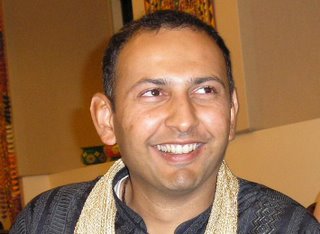 Sanjay Dalal
My son Ravi sent me link to the blog of a friend, battling metabolic bone disorder. Sanjay Dalal, 38, has Osteoporosis of the lumbar spine, and Ostopenia in couple of other areas. How does one be supportive towards a friend one just discovers to have been suffering from a disabling, painful and not easily curable disorder ? Sanjay, who had till now given no inkling, even to close friends, of his worsening condition, blogs, “I realize that friends may distance themselves because they perhaps don't know how they can support someone during a time such as this. However, just knowing that they are there, and I can even enjoy their company even through the occasional email and phone call, at times, is enough”.
Of his determination to fight the disease of the bone Sanjay says, “If Lance Armstrong can fight cancer, and come out fully recovered and then go on to win Tour De France several times, I can do better in my fight against Osteoporosis. I also have two young kids who are growing and who provide me every incentive every day of the week to become active, get better physically, and play with them”.
December 12, 2006
Putting a face to e-mail IDs in my address book
 I have been meaning to do this piece for a while, but couldn’t get down to it, presumably, due to the L-factor that seem to afflict many of us Mysoreans. L here stands for lethargy. I plead guilty to name-dropping, in the process of saying, thank-you, to those who turned up in response to my e-mail invite, and also those who wrote to say they wished they could make it, to the Regaalis on November 18 evening. They included veteran journalist Mr Krishna Vattam, who came to the hotel, only to leave a note at the reception desk, saying that he couldn’t join us because he didn’t not wish to pass on his cold & cough to the guests at the party.
I was looking forward to meeting him. We have been in e-mail touch for several months, but could not find time and occasion to meet each other till this date. The thing about our Nov.18 party was that it gave me an opportunity to put a face on many names in my e-mail address book. I also realized that quite a few of our guests had also not met one another earlier. The pretext for our get-together was to celebrate Siddarth who was visiting his grandparents in Mysore for the first time since birth one year ago.
Excited at our first meeting some of us traded promises to keep ourselves in closer touch. Dr.(Lt.Col.) Y N I Anand, a retired military doctor specialized in nuclear medicine, overwhelmed us by dropping in at our place the other day to deliver a CD of the pictures he had taken at Regaalis. I was equally touched by the gift of a book by the Madhavans. Must concede that, at the time of posting this piece, I had read only 55 pages of the 160-page novel, The Silver Pilgrimage by M Ananthanarayanan. Mr A Madhavan, our former envoy whose postings included Berlin and Tokyo, and his wife struck a connection with my son, who shares his first name with theirs. And both are based in California.
Dr Javeed Nayeem, cardiologist by profession, responded to my invite, in letter and spirit, by turning up with his wife, daughter and son. The doctor has, in recent months, blossomed into a widely read Star of Mysore columnist. My grouse is Dr Nayeem doesn’t write more and frequently for his blog, which is part of our new-found site – Mysore Blog Park.
Mrs & Mr T S Satyan (need I say who?) were among the first guests to arrive. A stickler for keeping time, the Satyans were there right on the dot, at 7.30 p m. I can brag that we have known each other since the early 60s, when Mr Satyan was a Life magazine photo-journalist, and I, a minion at the Press Information Bureau, New Delhi. Another Delhi connection of ours who showed up at Regaalis, from Chennai, was Mr Sam Rajappa of The Statesman. Mr Satyan mentioned that he had last met Sam Rajappa some 30 years back.
Another friend who came from Chennai was Mr M R Venkatesh of the Telegraph. Speaking of outstation guests I was pleased to meet my new-found blogger friends Mr C N Ramesh and Mr L Venkata Ranga, who came with wife and two-year old kid from Bangalore. Another out-of-towner who came to Mysore specifically for the party was Mr Vijendra Rao of Bangalore Bias. We count him among the five charter members of the now inactive MyMysore Forum.
My professional affinity with journalists probably accounts for the presence of quite a few of our tribe. Mysore media veteran Mr Gouri Satya and wife, who were not likely to come because of a previously committed engagement, showed up briefly. It was such endearing gestures, particularly by those I didn’t know long or well enough, that made my evening. Mr Srihari, a retired CFTRI scientist who has morphed into a Star of Mysore editorial writer, turned up even though he was nursing a fractured ankle. Another Mysorean who has taken to writing in his ‘second adulthood’, Mr E R Ramachandran, was there and wanted us to invent excuses for such gatherings with reasonable regularity. Of the NRI parents who turned up was Mr N D Bhagavan and his wife. I had got in touch with him after reading a media report on Mr Bhagavan's initiative to form an NRI Parents Association in Mysore. As was the case with most other e-mail contacts of mine, Mr Bhagavan and I were looking forward to meeting each other.
Must mention here the help I have had from two of our guests – Mr T Raghottam Rao, and Mr M B Nagakumar. A former Lions Club president who is into full time social work, Mr Rao, used his membership of the Cosmopolitan Club as well as the Institution of Engineers, to arrange much needed accommodation for rooming some of our outstation guests. Mr Nagakumar, a leading light in the Mysore chapter of the Builders Association of India, put in a word that weighed with the Regaalis management to give an appreciable discount on our food bill.
Notable among those who e-mailed to say they wished they could be there was Mr Shankar Prasad, an IT executive and active member of the Mysore IT Forum. Shanks, as he is generally addressed, said he couldn’t make it as he got caught up in a downpour while visiting a friend on way to the party. Energy consultant, Mr Shankar Sharma, was candid enough to tell me he wasn’t a partying type. Capt. Anup Murthy, an aviator-blogger, called from Goa on the morning of the party to say he had to be away from Mysore that day on a pressing engagement.
Periyar’s Brahmin connection
 The Hindu zealots who vandalized a statue of Periyar at Srirangam, Tamilnadu, the other day wouldn’t have known or cared to know that E V Ramasami Naicker (1879-1973), had once been a trustee of a Ganesha temple at his native Erode. I heard this from a journalist friend, N Nageswaran, whose family were friends and neighours of EVR’s at Court Street, Erode. Dubbed anti-God the Dravidian cult figure sustained the reputation by breaking idols of Hindu daities.
The social reform movement he launched had a pronounced anti-Brahmin edge. But, in his personal life, he had Brahmin friends, of whom the most notable was C Rajagopalachari. Mr Nageswaran refuted the commonly held belief that Periyar was a Brahmin-hater. Far from it, he held his Brahmin friends in high regard. When EVR , in his 70s, chose to marry, for the second time, a much younger woman, much to the resentment of his followers, including the current Tamilnadu CM Karunanidhi, he turned for advice and guidance to Rajaji. That EVR was given to abusing in public his Brahmin friend and then chief minister, Rajaji, was quite another matter, says Mr Nageswaran, who used to cover Periyar’s speeches as a reporter for Indian Express. He subsequently moved to the Economic Times, and retired as its Resident Editor in Bangalore.
Of EVR’s Brahmin connection Mr Nageswaran could claim personal knowledge. His school-teacher grandfather Kavandapadi Ananthanarayana Iyer was a close friend of EVR’s father E Venkata Naicker, And Mr Nageswaran had gone to school with a son of EVR’s brother. When his father was worried about young EVR’s waywardness it was Mr Nageswaran’s grandfather and some friends who helped set up a turmeric wholesale business for E Ramasami Naicker. He prospered in business so much that EVR became socially respectable enough to be a trustee of a Pilliar Temple at Erode. Irony was that Mr Nageswaran, who had known of his temple trustee background, was to witness EVR breaking Ganesh idols, as Indian Express reporter in Madras. The media, he said, used to make fun of him, but EVR couldn’t care less so long as the newspapers helped him stay in the limelight.
Recalling his earlier Erode days my media friend said EVR used to address public meetings at Erode’s Karaivaikkal maidan. Power connection for loudspeakers came from an electricity line drawn from an Iyer lawyer’s place close to the maidan. At one such meeting the Dravidian Kazhagam supremo, in an anti-Brahmin rant, called on his followers to go for Brahmins with scissors and have their sacred-thread snapped. As lawyer Dhandapani Iyer heard EVR holding forth on cutting off Brahmins’ sacred thread he cut off power to the public maidan, leaving the mike system dead .
Realising his tactical mistake EVR swiftly made amends by raising his voice, loudly enough for him to be heard by the advocate Iyer, that his followers must ensure sure that nice Brahmins such as Dhandapani Iyer were spared. Power connection got restored and EVR carried on his speech, avoiding references that could hurt the man who powered his public address system.
Long before he founded the black-shirt brigade, Dravida Kazhagam, Periyar had been a staunch Congressman and, as Mr Nageswaran put it, ardent Gandhian – ‘I have seen EVR hawking Khadi clothes, carried on his head, on the streets of Erode’. Gandhi had once stayed at EVR’s place at Erode. Mr Nageswaran reckoned that, if only EVR had stayed on in the Congress, and had he given his due place in the party hierarchy, the Congress might still be in power in Tamilnadu. EVR had left the Congress because he felt its Brahmin-dominant leadership – Salem Vijayaraghavachariyar and Satyamurthy – ignored the aspirations of non-brahmins. EVR believed he was ignored by party leadership in Tamilnadu for the only reason that he was non-Brahmin. And this one man’s belief gave rise to the Dravidian movement that has held the Congress party back from power in Tamilnadu, for decades now.
December 4, 2006
A Mysorean who didn't know his worth
T S Elliot said of Dr V Ramakrishna that he didn't know his own worth, like a flower that is not aware of its own fragrance. Dr S Radhakrishnan was full of admiration and very impressed by his profound modesty, and depth of his learning. Somerset Maugham, who wanted to shape a character in his book after him, couldn't get Dr Ramakrishna to talk about himself - 'in spite of my repeated requests for details about him he has been evading me very cleverly'. As Maugham put it, " it is strange that a person of this type is found these days when everyone clamours for undeserved recognition".
A Mysorean who now leads a retired life with his daughter in the US, Dr Ramakrishna, 82, in the words of his Nobel Laureate friend T S Elliot, ' shirks publicity of any sort and does not talk about himself'. I heard about him from his younger brother, Dr Ramaprasad of Chamarajapuram, a retired BHEL dentist now settled in Trichy. "His work is not recognised in India," Dr Ramaprasad said of his elder brother, "I'm sure very few here know of him".
Dr Ramakrishna, a Mysore University agri. science graduate, pursued higher studies in Paris, London and Edinburgh, and received an honorary LL.D from Berne University. Besides being an agro-scientist who has served the World Bank and the Universities of Bangalore and Jabalpur, Dr Ramakrishna retained an enduring interest in child development issues. A Ph.D in child psychology from Sorbonne, Paris, Dr Ramakrishna's UNESCO prize-winning book of 1952 - 'Freedom from Want in Early Life' - Has been published in 14 languages.
He donated the prize money and also the cash component of many of his 13 international awards to UNICEF. The National Defence Fund (set up in the wake of 1962 Chinese aggression) and the Hiroshima Fund were among the notable charities to which he donated his prize money. Apart from literary awards Dr Ramakrishna is a recipient of the Magsaysay (1984) and the King George V Gold Medal awarded by the Royal Psychological Society.
T S Elliot, in his convocation speech at Sorbonne, spoke of his association with Dr Ramakrishna and recalled their first meeting at Delhi airport in December 1951. the Nobel Laureate got held up in transit for four hours. Dr Ramakrishna accompanied Sir John and Lady Crombie, then on a visit to India, to the airport to spend time with a stranded Elliot. While the other three were busy talking 'shop' the young agricultural graduate just listened for about 25 minutes without uttering a word, "but smiling at some of our silly jokes".
So silent was he that the other three made fun of him in a bid to provoke Ramakrishna. A reluctant talker and a slow starter, but once he got going, Ramakrishna could talk "with ease and clarity" on a variety of subjects - literature, science, religion, philosophy, psychology, music dancing and arts. Entomology was his favourite, observed Elliot. The Crombies told Elliot about Ramakrishna's art criticism published in the 'Illustrated London News'. He was a good sportsman and represented his university in football and athletics and was champion in walking and middle distance running.
The man has a dual personality. As Elliot said, what was visible outside is 'all humble, quiet, unassuming and modest; and what isn't visible is the remarkable versatility, wide knowledge, generous heart and a remarkable strength of will". Elliot concluded his convocation speech with a few lines from Grey's Elegy, which, he said, applied to Dr Ramakrishna down to the last word:
Full many a gem of purest ray serene
The dark unfathomed caves of ocean bear,
Full many a flower is born to blush unseen
Losing its fragrance in the desert air.
A Mysorean who now leads a retired life with his daughter in the US, Dr Ramakrishna, 82, in the words of his Nobel Laureate friend T S Elliot, ' shirks publicity of any sort and does not talk about himself'. I heard about him from his younger brother, Dr Ramaprasad of Chamarajapuram, a retired BHEL dentist now settled in Trichy. "His work is not recognised in India," Dr Ramaprasad said of his elder brother, "I'm sure very few here know of him".
Dr Ramakrishna, a Mysore University agri. science graduate, pursued higher studies in Paris, London and Edinburgh, and received an honorary LL.D from Berne University. Besides being an agro-scientist who has served the World Bank and the Universities of Bangalore and Jabalpur, Dr Ramakrishna retained an enduring interest in child development issues. A Ph.D in child psychology from Sorbonne, Paris, Dr Ramakrishna's UNESCO prize-winning book of 1952 - 'Freedom from Want in Early Life' - Has been published in 14 languages.
He donated the prize money and also the cash component of many of his 13 international awards to UNICEF. The National Defence Fund (set up in the wake of 1962 Chinese aggression) and the Hiroshima Fund were among the notable charities to which he donated his prize money. Apart from literary awards Dr Ramakrishna is a recipient of the Magsaysay (1984) and the King George V Gold Medal awarded by the Royal Psychological Society.
T S Elliot, in his convocation speech at Sorbonne, spoke of his association with Dr Ramakrishna and recalled their first meeting at Delhi airport in December 1951. the Nobel Laureate got held up in transit for four hours. Dr Ramakrishna accompanied Sir John and Lady Crombie, then on a visit to India, to the airport to spend time with a stranded Elliot. While the other three were busy talking 'shop' the young agricultural graduate just listened for about 25 minutes without uttering a word, "but smiling at some of our silly jokes".
So silent was he that the other three made fun of him in a bid to provoke Ramakrishna. A reluctant talker and a slow starter, but once he got going, Ramakrishna could talk "with ease and clarity" on a variety of subjects - literature, science, religion, philosophy, psychology, music dancing and arts. Entomology was his favourite, observed Elliot. The Crombies told Elliot about Ramakrishna's art criticism published in the 'Illustrated London News'. He was a good sportsman and represented his university in football and athletics and was champion in walking and middle distance running.
The man has a dual personality. As Elliot said, what was visible outside is 'all humble, quiet, unassuming and modest; and what isn't visible is the remarkable versatility, wide knowledge, generous heart and a remarkable strength of will". Elliot concluded his convocation speech with a few lines from Grey's Elegy, which, he said, applied to Dr Ramakrishna down to the last word:
Full many a gem of purest ray serene
The dark unfathomed caves of ocean bear,
Full many a flower is born to blush unseen
Losing its fragrance in the desert air.
November 25, 2006
A health city Bangalore can do without
Read in the media that Karnataka government plans to acquire 500 acres to develop a health city near the upcoming Bangalore aireport at Devanahalli. I thought Bangalore would be the last place in the state that needs the government help in promoting such investment. Besides, medical tourism is not an area that is crying out for government promotion. If anything, the city needs to consolidate its growth to be able to serve the best interests of its residents. Infrastructure in Bangalore, such as roads, public transport, sewage disposal and affordable housing, are already stressed out as a result of haphard growth that is unmindful of its impact on quality of life of those who are constrained to live there.
A responsive government would think in terms of addressing the infrastructure situation and in regulating the growth factors contributing to this social malady, instead of aggravating the pressure on the woefully inadequate social infrastructure. The coming up of an international airport is bound to promote investment in varied sectors. And a government with foresight ought to be thinking in terms of developing health and other sector-specific townships, away from the city, within a 100 to 150 km radius, with well served rapid transit facilities.
The six-lane Bangalore-Mysore expressway project holds out opportunity for developing sector-centric, growth-oriented townships along the transitway. The expressway gains significance, not just because it can shorten Mysore-Bangalore travel time (to 90 minutes) but, more importantly, because it opens out prospects for growth oriented townships all along the expresseway. If the government is really concerned about betterment of its capital city and the greater Bangalore region, it ought to 1) facilitate early completion of Bangalore-Mysore expressway, in time to take advantage of investment triggered by the upcoming international airport; and 2) take steps to locate the proposed health city midway along the expressway.
A responsive government would think in terms of addressing the infrastructure situation and in regulating the growth factors contributing to this social malady, instead of aggravating the pressure on the woefully inadequate social infrastructure. The coming up of an international airport is bound to promote investment in varied sectors. And a government with foresight ought to be thinking in terms of developing health and other sector-specific townships, away from the city, within a 100 to 150 km radius, with well served rapid transit facilities.
The six-lane Bangalore-Mysore expressway project holds out opportunity for developing sector-centric, growth-oriented townships along the transitway. The expressway gains significance, not just because it can shorten Mysore-Bangalore travel time (to 90 minutes) but, more importantly, because it opens out prospects for growth oriented townships all along the expresseway. If the government is really concerned about betterment of its capital city and the greater Bangalore region, it ought to 1) facilitate early completion of Bangalore-Mysore expressway, in time to take advantage of investment triggered by the upcoming international airport; and 2) take steps to locate the proposed health city midway along the expressway.
November 10, 2006
Dhoni goes for a haircut; and the media goes ga-ga
Some cricketers, it seems, can’t even go out for a haircut without causing a law and order problem. The Ranchi police chief, Mr Akhilesh Kumar Jha, is reported to have made a plea to the city’s celebrity cricketer - “I’d request Dhoniji to please inform the police before he goes to any public place, so that it would be slightly easier for us to deal with such situation”. The situation the police chief refers to was a drive Mahendra Singh Dhoni tookthe other day to a neighbourhood shopping mall for a haircut.
A news agency report had it that some 2000 fans mobbed the mall, locking in Dhoni at Kaya Beauty Parlour, Ranchi, for well over four hours. The police were summoned to rescue and escort him home. Wow! What a story. The Hindu even carried a picture of the crush of Dhoni fans at the Ranchi mall. It became a media event because of Dhoni’s propensity to pull a crowd at the drop of his hair. It shows we have people who are prepared to drop everything to be wherever a test player is sighted.
Such is our craze for cricket, which, as Lord Mancroft put it, is ‘a game which the English, not being a spiritual people, have invented to give themselves some conception of Eternity’. My aged aunt’s take on cricket is plainly polemical. She says life would be a lot less miserable, if only they didn’t have the blessed live telecast. Her aversion to the game at any given time is directly proportionate to the level of her addiction to the daytime soap she is obliged to miss on the days of a live telecast of a cricket match. Her son and his son are cricket addicts, like millions of others who get glued to their TV sets, unmindful of the phenomenal national waste of man-days caused by cricket telecasts.
Every nation is entitled to its obsession. It is soccer in Brazil, baseball in US. Our consuming obsession is cricket. Unlike soccer or baseball, which has a season and relatively short duration of play, cricket is a day-long affair and played, nowadays, all the year round. Almost every match is telecast live and re-telecast during the ever shortening non-playing season. And there is a social dimension to the cricket telecast. It tends to interfere with your routine. You can't take the family out on days when a big match is on, nor would anyone visit you. And drawing room conversations, even within families, centre round finer points of something that someone did or didn't do at gully, slip or silly mid-on. You are made to look silly if you don't keep up with the live telecast. You can ignore the ball game at your social peril.
A news agency report had it that some 2000 fans mobbed the mall, locking in Dhoni at Kaya Beauty Parlour, Ranchi, for well over four hours. The police were summoned to rescue and escort him home. Wow! What a story. The Hindu even carried a picture of the crush of Dhoni fans at the Ranchi mall. It became a media event because of Dhoni’s propensity to pull a crowd at the drop of his hair. It shows we have people who are prepared to drop everything to be wherever a test player is sighted.
Such is our craze for cricket, which, as Lord Mancroft put it, is ‘a game which the English, not being a spiritual people, have invented to give themselves some conception of Eternity’. My aged aunt’s take on cricket is plainly polemical. She says life would be a lot less miserable, if only they didn’t have the blessed live telecast. Her aversion to the game at any given time is directly proportionate to the level of her addiction to the daytime soap she is obliged to miss on the days of a live telecast of a cricket match. Her son and his son are cricket addicts, like millions of others who get glued to their TV sets, unmindful of the phenomenal national waste of man-days caused by cricket telecasts.
Every nation is entitled to its obsession. It is soccer in Brazil, baseball in US. Our consuming obsession is cricket. Unlike soccer or baseball, which has a season and relatively short duration of play, cricket is a day-long affair and played, nowadays, all the year round. Almost every match is telecast live and re-telecast during the ever shortening non-playing season. And there is a social dimension to the cricket telecast. It tends to interfere with your routine. You can't take the family out on days when a big match is on, nor would anyone visit you. And drawing room conversations, even within families, centre round finer points of something that someone did or didn't do at gully, slip or silly mid-on. You are made to look silly if you don't keep up with the live telecast. You can ignore the ball game at your social peril.
November 4, 2006
Remembering Rajaji
During my recent Bangalore visit I spent an evening with Mr N Nageswaran, former resident editor of Economic Times. He lives alone, with his 2-year-old Dachshund, Randy, a much mis-spelt breed. In stark contrast to his working life, when Mr Nageswaran routinely invented reasons to turn down party invitations, not many call him or drop in for chat, after retirement. This includes his professional colleagues. Friends dropped out of his life after he lost his wife a few years back.
Our association dates back to the late eighties when we used to have adjacent cabins at the Times Group office on Nungambakkam Road, Chennai. Mr Nageswaran was in a reminiscent mood, talking about his early days as a newspaper reporter in the Madras edition of Indian Express, then under the control of the one and only Ramnath Goenka. Stuck inside his head were loads of stories, anecdotes and eminently bloggable material that could be melted down into words over a couple whiskies. He wasn’t interested, not in whiskey, but blogging.
I referred to our own media veteran in Mysore, Mr Krishna Vattam, who has taken to blogging lately (with much prodding from his daughter and with help from his school-going grandson who ran a computer crash course for grandpa). When I mentioned a blog post by Mr Vattam on an incident relating to Rajaji and Mr Nageswaran’s face lit up and he promptly related a C R quote. “Consistancy is a donkey’s virtue,” Rajaji told his critics, “why should I, an intelligent human being, be expected to be consistent”. This was CR’s response to those who took him on for joining the anti-Hindi agitation, after having introduced Hindi in schools when he was in power.
Rajaji did not tolerate the media mis-reporting him. He used to send a post card to the editor the next morning. Mr Nageswaran was among the few reporters the old man trusted - ‘so I used to be assigned to all Rajaji functions’. As a reporter he was occasionally summoned to his residence where Rajaji dictated a statement, laid out on an easy-chair and sipping steaming hot coffee. The reporter had to sit on the floor to take down dictation - ‘he always asked me to read back to him what I had taken down’.
Mr Nageswaran recalled that when Sir C P Ramaswami Ayyar joined the Swatantra Party founded by Rajaji, Nehru had called it a party of old men. In a rebuttal CR observed, “Pandit Jawaharlal Neru has called us a party of old men; I would like to tell you that Jawaharlal Nehru is not a spring chicken”. Mr Nageswaran was among the newspapermen who was present at the Madras Music Academy function (in 1956?) at which Nehru paid his much-quoted tribute to M S Subbulakshmi. “Who am I, a mere prime minister, to say anything about the queen of music”, Nehru told the gathering.
Our association dates back to the late eighties when we used to have adjacent cabins at the Times Group office on Nungambakkam Road, Chennai. Mr Nageswaran was in a reminiscent mood, talking about his early days as a newspaper reporter in the Madras edition of Indian Express, then under the control of the one and only Ramnath Goenka. Stuck inside his head were loads of stories, anecdotes and eminently bloggable material that could be melted down into words over a couple whiskies. He wasn’t interested, not in whiskey, but blogging.
I referred to our own media veteran in Mysore, Mr Krishna Vattam, who has taken to blogging lately (with much prodding from his daughter and with help from his school-going grandson who ran a computer crash course for grandpa). When I mentioned a blog post by Mr Vattam on an incident relating to Rajaji and Mr Nageswaran’s face lit up and he promptly related a C R quote. “Consistancy is a donkey’s virtue,” Rajaji told his critics, “why should I, an intelligent human being, be expected to be consistent”. This was CR’s response to those who took him on for joining the anti-Hindi agitation, after having introduced Hindi in schools when he was in power.
Rajaji did not tolerate the media mis-reporting him. He used to send a post card to the editor the next morning. Mr Nageswaran was among the few reporters the old man trusted - ‘so I used to be assigned to all Rajaji functions’. As a reporter he was occasionally summoned to his residence where Rajaji dictated a statement, laid out on an easy-chair and sipping steaming hot coffee. The reporter had to sit on the floor to take down dictation - ‘he always asked me to read back to him what I had taken down’.
Mr Nageswaran recalled that when Sir C P Ramaswami Ayyar joined the Swatantra Party founded by Rajaji, Nehru had called it a party of old men. In a rebuttal CR observed, “Pandit Jawaharlal Neru has called us a party of old men; I would like to tell you that Jawaharlal Nehru is not a spring chicken”. Mr Nageswaran was among the newspapermen who was present at the Madras Music Academy function (in 1956?) at which Nehru paid his much-quoted tribute to M S Subbulakshmi. “Who am I, a mere prime minister, to say anything about the queen of music”, Nehru told the gathering.
October 31, 2006
Mega-family household, dates back to Shivaji
Two is company; three, a crowd. When the number goes up to 180, it becomes a TV story. Deccan Herald correspondent Shyam Sundar Vattam wrote about a 180-member family in rural Dharwad that was featured in a BBC documentary. As Mr Vattam put it, the telecast has led to a steady flow of visitors to Lokur, a village 15 km from Dharwad. Lokur (which means people’s place) is home to the Narsinganavar family that has 180 members living under the same roof.
At an age when an increasing number of young couple are constrained by circumstances or contrive to live away from parents the Lokur family represents social anachronism. The mega-family phenomenon, I presume, is something peculiar to remote rural locations that are remote in more than a geographical sense. The BBC crew that went to film the Lokur family found they didn’t even have television. The crew donated a TV set so that the family could watch the BBC documentary on them.
I know of a mega-family at Avlegaon, Maharashtra, that is not accessible by road. An unmade cart-path stops a mile short of the Fauzdar household that had some 150 members when I visited them during Ganesh festival some 10 years back. It was a mansion-like house in the middle of a paddy field. It belonged to a fauzdar, who was the village land-record keeper and he registered births and deaths in the village, in Sindudurg district of Maharashtra.
I went to Avlegaon with Mr R S Sawant, a Chennai-based company CEO whose wife belonged to this village. Mrs Sawant traced back the Avlegaon settlement to the days of Shivaji. The villagers shared their surname with the Maratha ruler - Bhonsle. The fauzdar’s forefathers were in Shivaji’s army. When their menfolk went out to fight battles the women and children of the basti came to stay in the fauzdar’s house, which was built 300 years ago. The fauzdar family owns half the village land. According to Mr Sawant, they are self-sufficient in terms of their needs of rice, cereal, fruits, vegetables and milk.
The core strength of the household is around 80, mostly middle-aged people and young children of those employed in towns. Those of the employable age in the family have gone out of the village, to towns and cities such as Mumbai for employment. They make it back to Avlegaon for holidays and festivals. The house strength was 150 when Mr Sawant and I visited the village. We were there on a Ganesh chaturthi day.
At an age when an increasing number of young couple are constrained by circumstances or contrive to live away from parents the Lokur family represents social anachronism. The mega-family phenomenon, I presume, is something peculiar to remote rural locations that are remote in more than a geographical sense. The BBC crew that went to film the Lokur family found they didn’t even have television. The crew donated a TV set so that the family could watch the BBC documentary on them.
I know of a mega-family at Avlegaon, Maharashtra, that is not accessible by road. An unmade cart-path stops a mile short of the Fauzdar household that had some 150 members when I visited them during Ganesh festival some 10 years back. It was a mansion-like house in the middle of a paddy field. It belonged to a fauzdar, who was the village land-record keeper and he registered births and deaths in the village, in Sindudurg district of Maharashtra.
I went to Avlegaon with Mr R S Sawant, a Chennai-based company CEO whose wife belonged to this village. Mrs Sawant traced back the Avlegaon settlement to the days of Shivaji. The villagers shared their surname with the Maratha ruler - Bhonsle. The fauzdar’s forefathers were in Shivaji’s army. When their menfolk went out to fight battles the women and children of the basti came to stay in the fauzdar’s house, which was built 300 years ago. The fauzdar family owns half the village land. According to Mr Sawant, they are self-sufficient in terms of their needs of rice, cereal, fruits, vegetables and milk.
The core strength of the household is around 80, mostly middle-aged people and young children of those employed in towns. Those of the employable age in the family have gone out of the village, to towns and cities such as Mumbai for employment. They make it back to Avlegaon for holidays and festivals. The house strength was 150 when Mr Sawant and I visited the village. We were there on a Ganesh chaturthi day.
October 26, 2006
Infosys: Paying its social dues in China
As many as 50 of the 100 Chinese undergrads who went through a three-month course at Infosys training centre, Mysore, went back to work for other companies. They were not obliged to join Infosys, according to Infosys china CEO, Mr James Lin. The students who spent three months in Mysore represented the first batch of an Infosys sponsored internship programme.
The company website said China Scholarship Council together with Infosys selected 100 undergraduate students in their fourth year from leading universities in the software engineering field. The program involves a three-month intensive training course on interpersonal and technical skills at the Global Education Centre at Mysore, and a four-month internship at Infosys’ development center in Bangalore.
In return for the favour China is reported to have exempted Infosys China unit from the provisions of the labour law pertaining to trade unions. The Infosys unit in China has 700 employees, of whom 95 percent are Chinese. And they have no union. Mr Lin is reported in The Hindu as saying, “we will never let a trade union be formed here”. The Hindu’s Sandeep Dikshit, in an op-ed page piece says China needs a workforce that is talented and familiar with international practices and business environment. The Infosys sponsored internship programme partly takes care China’s HR needs. To quote Mr Lin (this time, from his company website), “We believe that a truly global company has a global view of not only markets, but people and culture. Through this initiative, along with our investments in China, we hope to provide Chinese software professionals with an opportunity to train on cutting edge technologies.”
Our students can also do with some company sponsored internship. As The Hindu report put it, Infosys paid its ‘social dues’ to China through the internship scheme. I don’t know if the company feels it owes anything to Mysore by way of ‘social dues’. Wouldn’t it be a good idea, if they were to sponsor a few seats in every training batch at the Mysore centre to the bright but socially disadvantaged students from Mysore ? Like China, we could also do with multinationals sponsoring internships to our students who lack employability skills. According to a Nasscom study, three out of every four engineers our educational institutions turn out are found to be deficient in tech. skills, fluency in English, ability to work in a team, and to deliver basic oral presentations.
At campus recruitment big companies skim off the best and the brightest. A company sponsored internship programme for some of those who are left out might be one way the corporate sector could pay its social dues to educational institutions.
The company website said China Scholarship Council together with Infosys selected 100 undergraduate students in their fourth year from leading universities in the software engineering field. The program involves a three-month intensive training course on interpersonal and technical skills at the Global Education Centre at Mysore, and a four-month internship at Infosys’ development center in Bangalore.
In return for the favour China is reported to have exempted Infosys China unit from the provisions of the labour law pertaining to trade unions. The Infosys unit in China has 700 employees, of whom 95 percent are Chinese. And they have no union. Mr Lin is reported in The Hindu as saying, “we will never let a trade union be formed here”. The Hindu’s Sandeep Dikshit, in an op-ed page piece says China needs a workforce that is talented and familiar with international practices and business environment. The Infosys sponsored internship programme partly takes care China’s HR needs. To quote Mr Lin (this time, from his company website), “We believe that a truly global company has a global view of not only markets, but people and culture. Through this initiative, along with our investments in China, we hope to provide Chinese software professionals with an opportunity to train on cutting edge technologies.”
Our students can also do with some company sponsored internship. As The Hindu report put it, Infosys paid its ‘social dues’ to China through the internship scheme. I don’t know if the company feels it owes anything to Mysore by way of ‘social dues’. Wouldn’t it be a good idea, if they were to sponsor a few seats in every training batch at the Mysore centre to the bright but socially disadvantaged students from Mysore ? Like China, we could also do with multinationals sponsoring internships to our students who lack employability skills. According to a Nasscom study, three out of every four engineers our educational institutions turn out are found to be deficient in tech. skills, fluency in English, ability to work in a team, and to deliver basic oral presentations.
At campus recruitment big companies skim off the best and the brightest. A company sponsored internship programme for some of those who are left out might be one way the corporate sector could pay its social dues to educational institutions.
October 24, 2006
Spreading the green message, Somnath style
It's the kind of story, I wish, the media would do more often. It is about a young man's effort to convey a green message in a down-to-details way that appeals to those with an accountant's mind. Whenever someone comes up with an idea or message, we tend to ask, 'what's in it for me'. Cost-benefit ratio is the key to sell anything. Which is what T N Somnath, a PUC student, has tried to figure out, to promote his case for saving trees from axemen.
A hundred year old tree, he says, is worth Rs.11.2 lakhs. How ?
Oxygen it produces is worth Rs. 2.5 lakhs
The soil erosion it stems saves Rs.2.5 lakhs
Impact on humidity - Rs.3 lakhs
Ecological benefits of a tree sheltering birds/insects - Rs.2.5 lakhs
Air pollution control - Rs.70,000
Put in such neatly calculated and tabulated format, it raises the question: How did Somnath come up with the numbers ? But I would let that pass.
The pertinent point is Somnath has come up with an imaginative way to create public awareness about the importance of trees. The next time you see full-grown tree being felled, you'd say, 'there goes Rs.11 lakh worth of our wealth'. Somnath is reported to have nailed printed notice boards, carrying his tabulated figures, on the trunks of a hundred old trees in Bangalore city. The credit for bringing the story of Somnath's crusade to save trees to public notice goes to The Hindu reporter Govind D Belgaumkar.
Great work, Somnath ; good show, Govind.
And then, S G Neginhal, retired forest service officer, says in Deccan Herald, a tree does the function of five air-conditioners in bringing down urban temperature. What's more, it harbours nocturnal birds such as owl that feed on rodents and mosquitoes, thereby keeping a check on the spread of rat fever, chikungunya, dengue and malaria.
A hundred year old tree, he says, is worth Rs.11.2 lakhs. How ?
Oxygen it produces is worth Rs. 2.5 lakhs
The soil erosion it stems saves Rs.2.5 lakhs
Impact on humidity - Rs.3 lakhs
Ecological benefits of a tree sheltering birds/insects - Rs.2.5 lakhs
Air pollution control - Rs.70,000
Put in such neatly calculated and tabulated format, it raises the question: How did Somnath come up with the numbers ? But I would let that pass.
The pertinent point is Somnath has come up with an imaginative way to create public awareness about the importance of trees. The next time you see full-grown tree being felled, you'd say, 'there goes Rs.11 lakh worth of our wealth'. Somnath is reported to have nailed printed notice boards, carrying his tabulated figures, on the trunks of a hundred old trees in Bangalore city. The credit for bringing the story of Somnath's crusade to save trees to public notice goes to The Hindu reporter Govind D Belgaumkar.
Great work, Somnath ; good show, Govind.
And then, S G Neginhal, retired forest service officer, says in Deccan Herald, a tree does the function of five air-conditioners in bringing down urban temperature. What's more, it harbours nocturnal birds such as owl that feed on rodents and mosquitoes, thereby keeping a check on the spread of rat fever, chikungunya, dengue and malaria.
October 10, 2006
A plate of fruits, stuffed and knitted

The latest Wonderweb mail, from Vibhuti Jain, has 10 photos captioned 'Knitted Food'. To know how these fruits are 'grown' and what it takes I Googled and found a knitting site - Jimmy Beans Wool. Besides Size 7 and darning needles you need dyed organic cotton yarn and polyester batting as stuffing material.
October 8, 2006
Take his tea, but vote for me

Shashi Tharoor, jeetega zaroor. That was the slogan on which he contested the St. Stephen's College Union election, 1974. In his column - The Hindu - Mr Tharoor writes the slogan turned out to be prophetic. His 'most memorable achievement', as college union president, was improving the quality of vegetarian food at the mess. Mr Tharoor had also kept his union out of the JP moment, a stance, he said, he later regretted during the Emergency.
I had won a campus election too. This was at the Delhi School of Economics (DSE), a few minutes walk across the road from the St. Stephen's. Unlike Mr Tharoor, I can't say I achieved anything . At DSE those days we didn't even have a canteen ,for me to improve the quality of its offerings. We used to stroll across to Ramjas College for snacks and smoke. Like Mr Tharoor, I had a regret. I could not keep DSE from joining the Delhi University Students Union.
Till my term DSE students had kept themselves away from the university union affairs. Our college didn't even call its students body as a union. At DSE we were part of, what they called, a 'fraternity', of which the president was DSE director. And the students elected the vice-president. It was during my term as VP the student body adopted a resolution, affiliating itself to the Delhi University Students Union. For the record, I cast my vote against the resolution.
The DSE Students 'Fraternity', presumably, hasn't since been the same again. Politics came to characterise student body election. Mine was the last term - 1959-60 - when election was won through a fraternal contest. My slogan against my only rival was : 'Take his tea, but vote for me'.
October 1, 2006
Medical ethics. Where's it ?


A surgeon who won't take kickbacks from the lab or radiology facility to which he/she sends patients; and won't give a cut to the physician who sent him the patient might lose referrals from other physicians.
Is he naive? Or is he just being ethical ?
Dr Abraham Verghese: I think in the US, and perhaps in India, we've drifted so far away from the ideal that we are not even aware that there is a standard that we're supposed to adhere to.
Dr Verghese, Director, Centre for medical humanities and ethics, University of Texas, addresses this and many other ethics issues in an interview with C K Meena that appears in The Hindu.
Author of My Own Country: a doctor's story, a best-selling memoirs about treating AIDS in smalltown USA, Dr Abraham Verghese was in India to attend a Clinical Ethics Conference at Christian Medical College, Vellore.
Subscribe to:
Posts (Atom)
