A school kid who can’t or wouldn’t declare his/her caste affiliation can fill in ‘Indian’ on the relevant dotted line, in the school admission form. Karnataka primary education minister, Mr Basavaraj Horatti is reported to have so announced in the state legislature. Let’s pray the minister sticks to his stand. He would have brought more cheer had he used the word ‘human’, instead of ‘Indian’, a term which in its commonly accepted sense, refers to nationality rather than caste. To be a human is to belong to one of the two universal castes, the other one being the caste of war-mongers.
In a sense, the minister’s choice of word is apt in our national context. For the word ‘Indian’ denotes a sense of solidarity that cuts across the regional and linguistic divides. Mr Horatti, however, made the statement in the context of nine Mysore school children who were denied transfer certificates because they had not mentioned their caste in their application for TC.
If the media has got the minister right, Mr Horatti is quoted as saying, “Any child not willing to or who cannot divulge his caste can, simply, write ‘indian’” (Deccan Herald, July 5). The statement opens out refreshing possibilities. Public spirited parents with pre-school children can now test the govt. intention, and break out of the castes-line by declaring their children’s caste as , simply, ‘Indian’, at the time of school admission.
Such concerted move would hold out a semblance of hope for India to become a casteless society in the generation after next. I use the term - semblance of hope - because a majority of us have a vested interest in highlighting our caste affiliation under the quota system. In the ultimate analysis we can become truly casteless only when the quota system goes away, and the caste clause is scrapped from all official forms, altogether.
July 4, 2006


July 2, 2006
Back in Mysore, to dead phone, un-ticking clocks
My phone had gone dead; the TV remote wasn’t working. I couldn’t access the Internet. And two of the three wall clocks at my place had stopped ticking. In short, my urban middle-class ‘life-support’ system was down. I realized I was back in Mysore, having been away for three months. Such things could happen anywhere, to anyone who has been gone for that long. My point is about getting things that had gone wrong back in running condition, without hassles. The time and effort it takes to get things done depends on where you live - Milpitas (Calif.), Mysore or outer Mongolia.
My scene is Mysore. Prof. Raghavan, my friend at a local b-school, would like to see Mysore become a dependable place for those who demand a certain quality in life, and promptness in service. As he put it, this town, which was My-sore (point) should be turned into ‘My-sure’(thing). As of now, it is a town where one can’t be sure of getting anything done right away or without hassle. The BSNL phone at my residence was dead. It took three phone calls to officials in strategic positions to get it ringing, this, within the same working day. A creditable performance in customer service for a public sector undertaking.
My problem is with the private sector that tom-toms about its customer-friendliness . I called the show-room that had sold me the TV to send a technician to fix my remote or have it replaced. The person who attended my call gave a patient hearing, assured me he would get the company’s service centre to attend to my TV remote before the end of the day (Saturday). When I didn’t hear from anyone for some hours I called the TV show-room again, only to be connected to someone else, who was polite, but wanted me to tell him about the faulty TV remote, all over again.
Mildly irritated, I mentioned that I had been through it all with so-and-so earlier in the day. “We have no such person here”, he said. This, I thought, was a bit thick. I had called the right show-room number; and spoken to a receptive person who heard me out, took down my phone number, and even wanted to know when it would be a convenient time for me to have the TV technician home. After all this, this show-room person, the second one I spoke to, wanted me to tell him what my complaint was about. He had no word of regret for what I (a ‘valued customer’) had been put through. And then, he said in a matter-of-fact tone, “I’d pass on your complaint to the company service centre, and they would attend to it Monday”.
When I mentioned that I had been given to understand my TV remote would be fixed the same day (I wanted to watch Germany-Argentina World Cup tie) the show-room guy talked me through their standard operating procedure. Which was, the service centre could not (or wouldn't) attend to any customer complaint on the very day it was reported. Besides, my complaint was made on a Saturday. So nothing could be expected to happen till Monday. So much for the customer-friendly (after sales) service centre.
My scene is Mysore. Prof. Raghavan, my friend at a local b-school, would like to see Mysore become a dependable place for those who demand a certain quality in life, and promptness in service. As he put it, this town, which was My-sore (point) should be turned into ‘My-sure’(thing). As of now, it is a town where one can’t be sure of getting anything done right away or without hassle. The BSNL phone at my residence was dead. It took three phone calls to officials in strategic positions to get it ringing, this, within the same working day. A creditable performance in customer service for a public sector undertaking.
My problem is with the private sector that tom-toms about its customer-friendliness . I called the show-room that had sold me the TV to send a technician to fix my remote or have it replaced. The person who attended my call gave a patient hearing, assured me he would get the company’s service centre to attend to my TV remote before the end of the day (Saturday). When I didn’t hear from anyone for some hours I called the TV show-room again, only to be connected to someone else, who was polite, but wanted me to tell him about the faulty TV remote, all over again.
Mildly irritated, I mentioned that I had been through it all with so-and-so earlier in the day. “We have no such person here”, he said. This, I thought, was a bit thick. I had called the right show-room number; and spoken to a receptive person who heard me out, took down my phone number, and even wanted to know when it would be a convenient time for me to have the TV technician home. After all this, this show-room person, the second one I spoke to, wanted me to tell him what my complaint was about. He had no word of regret for what I (a ‘valued customer’) had been put through. And then, he said in a matter-of-fact tone, “I’d pass on your complaint to the company service centre, and they would attend to it Monday”.
When I mentioned that I had been given to understand my TV remote would be fixed the same day (I wanted to watch Germany-Argentina World Cup tie) the show-room guy talked me through their standard operating procedure. Which was, the service centre could not (or wouldn't) attend to any customer complaint on the very day it was reported. Besides, my complaint was made on a Saturday. So nothing could be expected to happen till Monday. So much for the customer-friendly (after sales) service centre.
June 27, 2006
NYT freak copy

My home-delivered copy of NYT on Sunday had a thick grey strip running right down Page 10 of the Business Section, blacking out columns of classifieds. Was the freak page a piece of avant-garde art or an act of vandalism by a graffiti artist at work during the paper's print-run? Maybe none of the above. Maybe it's oversight on the part of the production staff. Whatever the case, the freak copy, I thought, was a collector's item. And I have saved it to be shown to friends and media buffs in Mysore. If only to show that things can go wrong, even at NYT.
My Google search of the company history, to check for any record of such botch-up, revealed a load of other trivia in the life of NYT since it was first published as the New-York Daily Times on Sept.1851. The thing about the paper is that it is rich not only in reading material but also in ruddi value (not in the US). The Sunday paper on Sept.13, 1987 reportedly weighed 12 pounds, containing 1,612 pages. The largest week-day edition was printed on April 19, 2000, with 174 pages.
The NYT masthead slogan - 'All the News That's Fit to Print' - first appeared on Oct.25, 1896, on the editorial page. It was moved to Page One, on Feb.10, 1897.
June 20, 2006
It isn’t that obvious to me, Dr Shenoy
Regarding GVK's idea of getting Mysoreans involved in civic problems through the medium of internet, I have to state the obvious that it is a non starter. First, there is a problem of few having the internet connection. And of those who have it, 90% are likely to be too "busy" to worry about the civic problems.
This is what Dr Bhamy Shenoy wrote in response to my post – Blog that empowers people. His premise may be right – not many in Mysore have the Internet access; and most of those who do, do not use it for much else other than to check/send e-mail. Assuming that we have around 10,000 Internet-connected residents in Mysore; and that 90 percent of them use it only for personal communication, we are looking at 1,000 odd Internet users who can potentially be engaged in interaction on issues of public concern.
MyMysore.com would be a thriving interactive forum, even if half their number can be initiated into ways of posting messages on the web and reacting to other people’s posts. Blogging is another way in which one can share one’s experience and put forward one’s point of view. At mymysore.com we have initiated into blogging a few public-spirited Mysoreans. It was a few months back that I phoned Capt. Anup Murthy, after reading his spirited letter-to-editor in Star of Mysore. He said he didn’t know much about blogging, but was willing to give it a shot.
I got in touch with Mr Vijendra Rao on reading about his website in a newspaper. He didn’t require my pep-talk on blogging. Mr Rao is a multi-blog person. More recently, we heard from Ms Vidya Nagaraj who stumbled on our site while on a web search for masale-puri recipe. We may not have helped her with the recipe, but our interactive enthusiasm for her quest touched her. She readily agreed to blog for us from her remote Japan town. Dr. Javeed Nayeem was another person I persuaded to blog for us after reading his column at Star of Mysore (what would I do without it?). The blogs that evoke comments are the ones that put across a point of view that is interesting, often informative, occasionally, controversial; and always authentic.
What has all this got to do with Dr.Shenoy’s question about involving people in civic problems through the Internet? Maybe the bloggers do not always write about civic issues (would be a bore, if they do), but they blog about their own things that interest readers; and many of them may be persuaded to interact on issues raised in the website discussion forum.
This is what Dr Bhamy Shenoy wrote in response to my post – Blog that empowers people. His premise may be right – not many in Mysore have the Internet access; and most of those who do, do not use it for much else other than to check/send e-mail. Assuming that we have around 10,000 Internet-connected residents in Mysore; and that 90 percent of them use it only for personal communication, we are looking at 1,000 odd Internet users who can potentially be engaged in interaction on issues of public concern.
MyMysore.com would be a thriving interactive forum, even if half their number can be initiated into ways of posting messages on the web and reacting to other people’s posts. Blogging is another way in which one can share one’s experience and put forward one’s point of view. At mymysore.com we have initiated into blogging a few public-spirited Mysoreans. It was a few months back that I phoned Capt. Anup Murthy, after reading his spirited letter-to-editor in Star of Mysore. He said he didn’t know much about blogging, but was willing to give it a shot.
I got in touch with Mr Vijendra Rao on reading about his website in a newspaper. He didn’t require my pep-talk on blogging. Mr Rao is a multi-blog person. More recently, we heard from Ms Vidya Nagaraj who stumbled on our site while on a web search for masale-puri recipe. We may not have helped her with the recipe, but our interactive enthusiasm for her quest touched her. She readily agreed to blog for us from her remote Japan town. Dr. Javeed Nayeem was another person I persuaded to blog for us after reading his column at Star of Mysore (what would I do without it?). The blogs that evoke comments are the ones that put across a point of view that is interesting, often informative, occasionally, controversial; and always authentic.
What has all this got to do with Dr.Shenoy’s question about involving people in civic problems through the Internet? Maybe the bloggers do not always write about civic issues (would be a bore, if they do), but they blog about their own things that interest readers; and many of them may be persuaded to interact on issues raised in the website discussion forum.
June 18, 2006
Healthcare outsourcing
Head of cardiology at a corporate hospital in Chennai told me once (this was years ago) that they needed to do 12 surgeries a day to be able to maintain three operation theatres, meet loan repayment schedule on equipment, and fulfill dividend expectations of shareholders. He was not merely a reputed cardiac surgeon, but also a board member – ‘I’ve to take care of the shareholders’ interests’.
Specialty hospitals have emerged good business, a sure-fire foreign exchange earners and have made India a destination for healthcare outsourcing. We hear hospital management circles talking of ‘medical tourism’, a term I despise. Overseas visitors in need of surgery and their concerned companions do not exactly fit the definition of ‘tourists’, a word I would normally associate with vacationers and pleasure-seekers. Travelling to get a heart bypass can’t be much fun. Most of those making the trip to India are folks who can’t afford it in their own country. Heart surgery that costs $200,000 in the US can be done in India for $10,000.
Hip resurfacing costs in Mumbai $6,000 while the same surgical procedure done in the US would set you back by $25,000. If you don’t have insurance cover in the US, and can’t raise that kind of money, even the Lord would be reluctant to help. I once met a lady at a Phoenix soup kitchen whose family became homeless, because her husband got pneumonia. His insurance cover had lapsed. And they had to sell their house to pay hospital bills. It was a matter of $11,000.
Thousands of US patients are said to be opting India as healthcare alternative, to take advantage of the cut-rate heart surgery, gastric bypass and hysterectomies. Economics professor Milica Bookman, of Philadelphia St. Joseph’s University, is quoted in People magazine as saying, “from what we’re hearing, the quality of care is certainly as good as what you find in an American hospital”. The professor is writing a book on medical outsourcing.
A school bus driver in Lakeville, Minn., who had hip resurfacing done in Mumbai has set up a website to share her experience and offer guidance to those looking at healthcare options in India.
Specialty hospitals have emerged good business, a sure-fire foreign exchange earners and have made India a destination for healthcare outsourcing. We hear hospital management circles talking of ‘medical tourism’, a term I despise. Overseas visitors in need of surgery and their concerned companions do not exactly fit the definition of ‘tourists’, a word I would normally associate with vacationers and pleasure-seekers. Travelling to get a heart bypass can’t be much fun. Most of those making the trip to India are folks who can’t afford it in their own country. Heart surgery that costs $200,000 in the US can be done in India for $10,000.
Hip resurfacing costs in Mumbai $6,000 while the same surgical procedure done in the US would set you back by $25,000. If you don’t have insurance cover in the US, and can’t raise that kind of money, even the Lord would be reluctant to help. I once met a lady at a Phoenix soup kitchen whose family became homeless, because her husband got pneumonia. His insurance cover had lapsed. And they had to sell their house to pay hospital bills. It was a matter of $11,000.
Thousands of US patients are said to be opting India as healthcare alternative, to take advantage of the cut-rate heart surgery, gastric bypass and hysterectomies. Economics professor Milica Bookman, of Philadelphia St. Joseph’s University, is quoted in People magazine as saying, “from what we’re hearing, the quality of care is certainly as good as what you find in an American hospital”. The professor is writing a book on medical outsourcing.
A school bus driver in Lakeville, Minn., who had hip resurfacing done in Mumbai has set up a website to share her experience and offer guidance to those looking at healthcare options in India.
June 12, 2006
Worth(lessness) of an MBA
There is hardly any university worth the name that doesn’t offer an MBA programme. With increasing number of graduates seeking admission there is growing skepticism about the worth of an MBA, that is generally perceived as the most versatile degree that opens many doors of employment. A management professor at McGill, Montreal, Henry Mintzberg, tracked the performance of 19 academically good students of the Harvard Business School (the class of 1990) some 13 years after they graduated (in 2003).
He came up with the conclusion that 10 of the 19 considered themselves “utter failures”, another four rated their performance as “very questionable”, and only five out of the lot did well. The yardstick of success comprised factors such as 1) personal satisfaction with one’s job 2) the respect of one’s peers; and 3) holding a top post – CEO, CFO – at a corporation. Oddly, salary level expectations ranked lower in order of importance; and some MBAs included in their mix of success priorities a capability to make a difference to society.
Prof. Mintzberg is cited in NYT as saying that managers can’t be created in classrooms. If b-schools give people who aren’t management material the impression that they can be turned into managers, they create hubris.
He came up with the conclusion that 10 of the 19 considered themselves “utter failures”, another four rated their performance as “very questionable”, and only five out of the lot did well. The yardstick of success comprised factors such as 1) personal satisfaction with one’s job 2) the respect of one’s peers; and 3) holding a top post – CEO, CFO – at a corporation. Oddly, salary level expectations ranked lower in order of importance; and some MBAs included in their mix of success priorities a capability to make a difference to society.
Prof. Mintzberg is cited in NYT as saying that managers can’t be created in classrooms. If b-schools give people who aren’t management material the impression that they can be turned into managers, they create hubris.
June 4, 2006
We’ve too few pigs, too many people
Reynolds is a small town in Indiana where people are outnumbered by pigs, in a ratio of 1: 300. Folks there are so well endowed with cows and pigs that they have decided to go for bio-renewable energy in a big way; generate electricity from animal waste and produce natural gas with the methane from the wastes of pigs, cows, and people.
Reynolds has been declared the first bio-town in the US that seeks to be come zero-dependant on conventional energy fuel. An old resident, who blames the rise fuel prices on Arab nations, is quoted in NYT as saying they needed to be shown that ‘we can do it (find our own energy), and we don’t need them’.This Indiana town has 533 residents, and it can count on adequate supply of bio-waste from 150,000 pigs and a comparable number of cows to meet all its energy needs.
I can’t see Mysore drawing power from pigs. We don’t have that many of them. At the last count they numbered around 18,000 in the entire Mysore town. Which makes for a dismal pig-people ratio. Our problem: we have too few pigs; and too many people.
Reynolds has been declared the first bio-town in the US that seeks to be come zero-dependant on conventional energy fuel. An old resident, who blames the rise fuel prices on Arab nations, is quoted in NYT as saying they needed to be shown that ‘we can do it (find our own energy), and we don’t need them’.This Indiana town has 533 residents, and it can count on adequate supply of bio-waste from 150,000 pigs and a comparable number of cows to meet all its energy needs.
I can’t see Mysore drawing power from pigs. We don’t have that many of them. At the last count they numbered around 18,000 in the entire Mysore town. Which makes for a dismal pig-people ratio. Our problem: we have too few pigs; and too many people.
May 31, 2006
Beating the liquor ban
Scene: Tehran, during the revolution, when the US newspaper correspondents kept body and soul together with a daily lunch at Leon’s Russian Grill, featuring borscht, double portion of caviar with blini and vodka. Everything went well till prohibition was declared in new Iran.
“For my chum William Tuohy of The Los Angeles Times and me, this marked the end of civilized life as we had known it …On the first day of prohibition our regular waiter pulled a long face, …carefully explained the new order of things and suggested 7Up as an appropriate alternate beverage.
“Resourceful fellows, those Iranians. When the bottles of “soda” arrived with our lunch – you must have guessed by now – they were filled with vodka” - R W Apple Jr., associate editor, in The New York Times Magazine (May 28, 2006)
Every other journalist must have a prohibition tale. I have a couple to recall. During a conducted tour of media film critics to Bombay (under prohibition) in late sixties we were put up at MLAs hostel, where M Shamim of The Times of India, Debu Mazumdar of Indian Express, and I (used to be then with National Herald) had separate rooms, but chose to share a single bathroom, where we found a convenient closet for our pre-mixed rum and water. We learnt later that some of our more daring colleagues in the press party sipped it out of a tea cup held openly on their bedside table. They had found a resourceful room boy to bring in the ‘beverage’ in tea-pots.
Of course Bombay-based media were amused at our uninformed ways. They went for tenements in Colaba and fishermen’s huts in Varsova that morphed into an ‘adda’ during evenings for their favourite peg with churmuri.
“For my chum William Tuohy of The Los Angeles Times and me, this marked the end of civilized life as we had known it …On the first day of prohibition our regular waiter pulled a long face, …carefully explained the new order of things and suggested 7Up as an appropriate alternate beverage.
“Resourceful fellows, those Iranians. When the bottles of “soda” arrived with our lunch – you must have guessed by now – they were filled with vodka” - R W Apple Jr., associate editor, in The New York Times Magazine (May 28, 2006)
Every other journalist must have a prohibition tale. I have a couple to recall. During a conducted tour of media film critics to Bombay (under prohibition) in late sixties we were put up at MLAs hostel, where M Shamim of The Times of India, Debu Mazumdar of Indian Express, and I (used to be then with National Herald) had separate rooms, but chose to share a single bathroom, where we found a convenient closet for our pre-mixed rum and water. We learnt later that some of our more daring colleagues in the press party sipped it out of a tea cup held openly on their bedside table. They had found a resourceful room boy to bring in the ‘beverage’ in tea-pots.
Of course Bombay-based media were amused at our uninformed ways. They went for tenements in Colaba and fishermen’s huts in Varsova that morphed into an ‘adda’ during evenings for their favourite peg with churmuri.
May 29, 2006
Deepa Mehta’s pretentious ‘Water’

I don’t know if Deepa Mehta’s ‘Water’ has yet been released in India. In the US it has received much hype; and the film is playing in San Francisco and some theatres in the Bay Area, California, to critical acclaim. I couldn’t stand it for more than 20 minutes. And I am not an RSS activist. My contempt for such cinematic effort stems from a lack of sensitivity in filming. When its maker faced problem from Hindu activists during the shoot much was made in some quarters of India’s intolerance to freedom of expression.
It is not as if no film had been made on our socially-sanctioned cruelty to child widows. I recall a Kannada film (cannot remember the name) made over two decades ago that handled the plight of our women in such circumstances with sympathy and sensitivity. The film advocated widow remarriage at time when it was not socially fashionable to do so.
‘Water’ has high production value that facilitates a gullible audience to gloss over the film’s treatment of the theme. Deepa Metha’s ‘Water’ is pretentious. Director appears to relish dwelling on travails of a child widow, at a slow-moving pace with lingering shots of disagreeable rituals, such as shaving the head of a widowed child in exasperating detail. You don’t need to capture in close-up every movement of the barber’s razor over the scalp of a sobbing child.
May 25, 2006
Media correctness
I know you wouldn’t believe when I say I’m not rubbing it in on Star of Mysore. But I couldn’t resist posting this entry about Craig Silverman’s E&P Weekly column – Rosenthal’s Legacy: The Corrections. Didn’t know, did you, that the late A M Rosenthal, former NYT exec. editor, standardized the practice of printed corrections issued in newspapers. The Los Angeles Times wrote, "When the newspaper erred, he insisted that it admit its mistakes in a daily Corrections column, which he introduced in 1972. He later added the Editor's Note, which addressed flaws such as errors of omission and lapses in taste and standards."
Rosenthal's successor, Max Frankel, is credited with his own tweak on the correction by insisting on standardizing how they are written. E&P columnist Craig Silverman who is credited with having studied over 100,000 corrections published in newspapers and magazines says 1) corrections don’t work’ and 2) they aren’t the best way to ensure that readers get the correct information.
Because a) very few readers read corrections; b) they can’t be bothered to scan the ‘corrections’ column to see if something they read yesterday or the day before was incorrect; and c) phrasing of corrections do not always offer a clear explanation for the error or adequate clarification of the misleading information.
“Today's corrections are often too brief, too obscure. They read like the hurried work of an editor tasked with an unpleasant chore, or, in the worst examples, they come off as the result of an effort to conceal rather than disclose. The reality is corrections exist more to absolve a publication than inform readers”, says Silverman, who edits Regret the Error, a website reporting on corrections, retractions, clarifications, and trends regarding accuracy and honesty in the media.
Rosenthal's successor, Max Frankel, is credited with his own tweak on the correction by insisting on standardizing how they are written. E&P columnist Craig Silverman who is credited with having studied over 100,000 corrections published in newspapers and magazines says 1) corrections don’t work’ and 2) they aren’t the best way to ensure that readers get the correct information.
Because a) very few readers read corrections; b) they can’t be bothered to scan the ‘corrections’ column to see if something they read yesterday or the day before was incorrect; and c) phrasing of corrections do not always offer a clear explanation for the error or adequate clarification of the misleading information.
“Today's corrections are often too brief, too obscure. They read like the hurried work of an editor tasked with an unpleasant chore, or, in the worst examples, they come off as the result of an effort to conceal rather than disclose. The reality is corrections exist more to absolve a publication than inform readers”, says Silverman, who edits Regret the Error, a website reporting on corrections, retractions, clarifications, and trends regarding accuracy and honesty in the media.
May 23, 2006
A reporter inhales skepticism
We have, in this blog, raised such a ruckus (Capt. Murthy, Mr Rao and I, not necessarily in that order) over a certain Star of Mysore story that I can understand if you feel we are over-doing it. But then seeing Capt. Murthy’s ‘chutpati’ comment to a ‘Media Muddle’ blog post, I thought of adding my spoonful of ‘ghee’ to the blaze by plagiarizing something I read on the attributes of a responsible journalist and responsive journalism.
Every reporter inhales skepticism. You interview people and they lie. You face public figures, diligently making notes or taping what is said, and they perform their interviews to fit a calculated script. The truth, alas, is always elusive….The newspaper reporter’s daily struggle is against deadlines and column inches, time and space.
The italicized lines in bold have been nicked from NYT book review by Pete Hamill, of David Remnick’s ‘Reporting’. The author was a Washington Post reporter before he became ‘New Yorker’ editor. And during his apprenticeship at the Post Remnick often covered homicides, giving it his all, only to be told by a night editor: “Two paragraphs. Slug it, ‘slay’ ”.
Another lesson that Remnick learnt: the best reporting doesn’t simply look at the world; it tries to see beyond the obvious surface. The reporter goes places the average reader never visits; the reporter must make that fragment of the world understandable with details….He goes places, talks to many people and comes back to tell his readers what he has learned. And like any reporter who learns from what he experiences, he knows that the world contains very few saints.
Modesty remains a primary virtue of any good reporter….As a writer Remnick practices a classic journalistic style: concrete nouns, active verbs, graceful sentences, solid paragraphs, subtle transitions….As a writer he treats the reader as an informed, intelligent equal. As an editor, he wants to make the writer’s work better.
Those who happen to read this post would do me a favour by spreading the word about this piece of plagiarism to any reporter they might know, or anyone they know, who might know of a newspaper person.
Every reporter inhales skepticism. You interview people and they lie. You face public figures, diligently making notes or taping what is said, and they perform their interviews to fit a calculated script. The truth, alas, is always elusive….The newspaper reporter’s daily struggle is against deadlines and column inches, time and space.
The italicized lines in bold have been nicked from NYT book review by Pete Hamill, of David Remnick’s ‘Reporting’. The author was a Washington Post reporter before he became ‘New Yorker’ editor. And during his apprenticeship at the Post Remnick often covered homicides, giving it his all, only to be told by a night editor: “Two paragraphs. Slug it, ‘slay’ ”.
Another lesson that Remnick learnt: the best reporting doesn’t simply look at the world; it tries to see beyond the obvious surface. The reporter goes places the average reader never visits; the reporter must make that fragment of the world understandable with details….He goes places, talks to many people and comes back to tell his readers what he has learned. And like any reporter who learns from what he experiences, he knows that the world contains very few saints.
Modesty remains a primary virtue of any good reporter….As a writer Remnick practices a classic journalistic style: concrete nouns, active verbs, graceful sentences, solid paragraphs, subtle transitions….As a writer he treats the reader as an informed, intelligent equal. As an editor, he wants to make the writer’s work better.
Those who happen to read this post would do me a favour by spreading the word about this piece of plagiarism to any reporter they might know, or anyone they know, who might know of a newspaper person.
May 22, 2006
If mom says, ’I love you’, check it out
Can’t think of a more journalistic definition of skepticism. Now The New York Times public editor Byron Calame has redefined the mom-says version, saying, ‘when there’s a story that’s likely to make readers go “Wow,” it should be checked twice’. The world’s best known newspaper carried a ‘wow’ story recently. So did our own Star of Mysore. And neither had checked it out.
Irony is the story both newspapers mishandled had to do with aviation. They played it on Page One. Both newspapers got the facts wrong. And both ‘left the incorrect story unaddressed publicly’ (for a week, in the case of NYT). The NYT story pertained to Airbus supposedly planning an aircraft with ‘standing room’ only for economy class passengers. This way they could accommodate as many as 853 passengers. The story said the aircraft maker was pitching the idea to Asian airlines, for short-haul routes.
The Star of Mysore story referred to a state government official reportedly speaking of a proposal to develop an international airport in Mysore. A story that worked up our aviator blogger, Capt. Anup Murthy, to raise turbulence in a coffee tumbler.
Both stories had, what Calame would term, the ‘wow’ factor and made their way to the front page ‘hardly meeting a skeptical eye’ in their editorial staff. NYT didn’t seek Airbus comment on the stand-up seat idea. SoM failed to ask the bureaucrat any specific question on the feasibility of the supposed proposal for an international airport in Mysore. However, senior journalist Mr Gouri Satya in a blog comment said the Karnataka official, in apparent response to the SoM misreporting, made it clear the next day that her reference was to Mangalore, not Mysore.
Neither NYT nor SoM came out with a correction soon after their mistake came to light. Delayed correction had its fallout. The NYT story resulted in publication of the stand-up seat story in several other newspapers. In Mysore SoM’s misleading report was, presumably, the basis for a comment by a Singapore Airlines executive welcoming the idea of an international airport for Mysore.
After the NYT mess the last word came from its public editor, who wrote that the Times editors at all levels needed to pick up each story with the assumption that aspects of it, or even the central premise could be wrong. Readers deserve no less. (Italics are mine). Till the time of blogging this post we haven’t had a word from SoM by way of correction. Readers deserve a lot more.
Irony is the story both newspapers mishandled had to do with aviation. They played it on Page One. Both newspapers got the facts wrong. And both ‘left the incorrect story unaddressed publicly’ (for a week, in the case of NYT). The NYT story pertained to Airbus supposedly planning an aircraft with ‘standing room’ only for economy class passengers. This way they could accommodate as many as 853 passengers. The story said the aircraft maker was pitching the idea to Asian airlines, for short-haul routes.
The Star of Mysore story referred to a state government official reportedly speaking of a proposal to develop an international airport in Mysore. A story that worked up our aviator blogger, Capt. Anup Murthy, to raise turbulence in a coffee tumbler.
Both stories had, what Calame would term, the ‘wow’ factor and made their way to the front page ‘hardly meeting a skeptical eye’ in their editorial staff. NYT didn’t seek Airbus comment on the stand-up seat idea. SoM failed to ask the bureaucrat any specific question on the feasibility of the supposed proposal for an international airport in Mysore. However, senior journalist Mr Gouri Satya in a blog comment said the Karnataka official, in apparent response to the SoM misreporting, made it clear the next day that her reference was to Mangalore, not Mysore.
Neither NYT nor SoM came out with a correction soon after their mistake came to light. Delayed correction had its fallout. The NYT story resulted in publication of the stand-up seat story in several other newspapers. In Mysore SoM’s misleading report was, presumably, the basis for a comment by a Singapore Airlines executive welcoming the idea of an international airport for Mysore.
After the NYT mess the last word came from its public editor, who wrote that the Times editors at all levels needed to pick up each story with the assumption that aspects of it, or even the central premise could be wrong. Readers deserve no less. (Italics are mine). Till the time of blogging this post we haven’t had a word from SoM by way of correction. Readers deserve a lot more.
May 19, 2006
A question of media priority
Here is something for my friend Vijendra to mull over in his media blog. There are more media people in Africa watching out for Brangelina’s birth than those covering the situation in Darfur. Says who? Says my neighbourhood newspaper in San Ramon, CA.. When the story gets printed it would carry an exotic dateline: Swakopmund, Namibia. It’s a resort in an otherwise desert country.
Occasion: Angelina Jolie (don’t ask who, for I’m not sure myself) is about to give birth to Brad Pitt’s baby.
Pre-birth scoop: London’s ‘Daily Mirror’ reports that an unidentified US-based weekly has signed a $5 m deal for rights to the baby’s first pix. The money is to be donated to UNICEF.
Question: Does anyone know/care about whatever is happening in Darfur, any more ?
Brangelina: Brad+Angelina
Occasion: Angelina Jolie (don’t ask who, for I’m not sure myself) is about to give birth to Brad Pitt’s baby.
Pre-birth scoop: London’s ‘Daily Mirror’ reports that an unidentified US-based weekly has signed a $5 m deal for rights to the baby’s first pix. The money is to be donated to UNICEF.
Question: Does anyone know/care about whatever is happening in Darfur, any more ?
Brangelina: Brad+Angelina
May 18, 2006
Couch potatoes club-up
Long Beach (California) Society of Couch Potatoes has codified a ten-point exercise programme for members - 1) skating on thin ice, 2) casting aspersions, 3) throwing caution to the wind, 4) bending the truth; 5) digging up dirt; 6) flogging a dead horse; 7) going the extra mile; 8) jumping to conclusions; 9) lashing out, and 10) marching to a different drummer......... It is my firm belief that Coonoorians (and many of us in Mysore) are in no way less accomplished than Californians on any of the ten counts.
My own favorite is flogging a dead horse......And we're one better than Californians; we are much too lazy even to organise themselves on the lines of the lazy ones of Long Beach....Read more (if you are inclined and aren't too lazy to exert yourself) by clicking on Recycled Writings.
My own favorite is flogging a dead horse......And we're one better than Californians; we are much too lazy even to organise themselves on the lines of the lazy ones of Long Beach....Read more (if you are inclined and aren't too lazy to exert yourself) by clicking on Recycled Writings.
May 17, 2006
Worrying over change
If you worry about things you can change, then change them so you don't worry. If you worry about things you cannot change, don't worry because you can't change them. So said Reto Wittwer citing a Buddhist saying. The real worry, as I see it, is some of us lack the wisdom to sort out things we can change from those we can't.
Mr Wittwer is the chief executive of Kempinski hotels group, and a Buddhist by accident. As he put it in a New York Times interview, "When I was young I married a Vietnamese girl, who was Buddhist. Her parents said, 'It's Buddhist or nothing'. I said O.K". He is Swiss, and his first language is Rhaeto-Romansh, a Latin-based 'gypsy mismash', one of Switzerland's four official languages.
Mr Wittwer is the chief executive of Kempinski hotels group, and a Buddhist by accident. As he put it in a New York Times interview, "When I was young I married a Vietnamese girl, who was Buddhist. Her parents said, 'It's Buddhist or nothing'. I said O.K". He is Swiss, and his first language is Rhaeto-Romansh, a Latin-based 'gypsy mismash', one of Switzerland's four official languages.
May 14, 2006
Cooker whistle scares babies
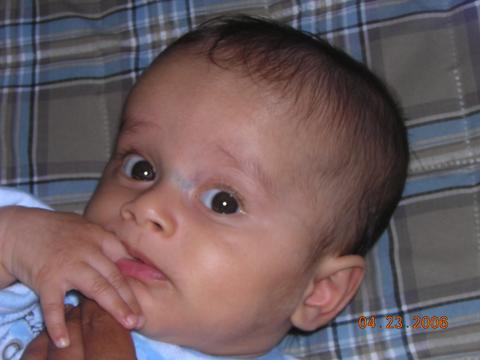
I thought it is just Sidharth, my 5-month old grandson, who gets scared by a whistling pressure cooker, till I read NRIPulse.com. The website for Indian families in the US runs a ‘baby of the fortnight' feature that carries every other week the profile of a child. Parents are invited to mail a set of pix. of their child, along with a note on the baby’s likes, dislikes, and any noticeable skills. Editor (or is it a baby jury) selects one of the entries for web-lication every fortnight.
Photo : Sidharth, in contemplative mode, when the cooker isn't whistling.
Scanning NRIPulse ‘Baby of the Fortnight’ archives I found quite a few parents listing pressure cooker whistle as a scary item. We’re talking about infants from four to 12 months. Why can’t we have a silencer fitted in to kill that noise ? Maybe housewives should represent to the cooker makers. If they can’t kill the shrill, manufacturers could think of modulating it to produce a Himesh Reshamiya number. I hear he is adept in making music (or what passes for it) out of piercing sounds.
May 8, 2006
The Coonoor connection
A nice thing about blogging is it enables connectivity that transcends memory; insofar as it re-connects one-time friends who have long ceased to remember each other. I heard from such a friend, Mr Marshall Gass in New Zealand, the other day, for no reason other than that he happened to Google something I wrote in zine5 some time back – ‘And so I must write to GVK and say Hi’. The zine5 piece had “stirred the tentacles of an old memory”.
Mr Gass used to blog in a Coonoor site I hosted before moving to Mysore. Of the site, Mr Gass, who had left Coonoor over 35 years back, wrote; “So many mates from the old school days have made contact since my e-mail went on this site (Coonoor Connection) – Hindley, Ramamurthy, Francis Mathews, Eates. Amazing. It was the best fun in the world, catching up with those guys I played marbles with 35 years back”.
In his e-mail this Coonoor-connected New Zealander said his memories of the place were ‘browned and faded like an antique photograph’ and described Coonoor as ‘epitaph of a cherubic dream’. “The contacts appeared and disappeared, and once in a while I get the do-you-remember-me story”, writes Mr Gass, “I most often do”.
I write to him saying we have moved on to Mysore, and had to abandon the Coonoor site, now dead out of sheer neglect. But then Mr Gass has a Mysore connection as well. Look up his blog entry in Impressions – ‘Up close and cheeky with Mysore crocs’.
Mr Gass used to blog in a Coonoor site I hosted before moving to Mysore. Of the site, Mr Gass, who had left Coonoor over 35 years back, wrote; “So many mates from the old school days have made contact since my e-mail went on this site (Coonoor Connection) – Hindley, Ramamurthy, Francis Mathews, Eates. Amazing. It was the best fun in the world, catching up with those guys I played marbles with 35 years back”.
In his e-mail this Coonoor-connected New Zealander said his memories of the place were ‘browned and faded like an antique photograph’ and described Coonoor as ‘epitaph of a cherubic dream’. “The contacts appeared and disappeared, and once in a while I get the do-you-remember-me story”, writes Mr Gass, “I most often do”.
I write to him saying we have moved on to Mysore, and had to abandon the Coonoor site, now dead out of sheer neglect. But then Mr Gass has a Mysore connection as well. Look up his blog entry in Impressions – ‘Up close and cheeky with Mysore crocs’.
May 5, 2006
Coping with stray cows in California
San Ramon: A newspaper reader in our neighbourhood paper shares her thoughts on coping with stray cows on hiking trails. For someone from Mysore, where I confront cattle on streets whenever I stir out of house, any advice on tackling cows is of interest. Here is what the Californian cow adviser has to say:
“They (cows) seem to consider us (humans) a threat only if they perceive us to be staring at them. My husband and I have the following conversation while approaching cattle on the trails. We don’t look at them; instead, say to each other ‘I don’t see a cow, do you?’, I say. He says, ‘no, I don’t see any cows either’
“Calm voices seem to help. We’ve walked by cows so close we could have touched them. They don’t run or even move. I think they think we don’t see them. It’s as if they don’t see us, either. I highly recommend this technique”
“They (cows) seem to consider us (humans) a threat only if they perceive us to be staring at them. My husband and I have the following conversation while approaching cattle on the trails. We don’t look at them; instead, say to each other ‘I don’t see a cow, do you?’, I say. He says, ‘no, I don’t see any cows either’
“Calm voices seem to help. We’ve walked by cows so close we could have touched them. They don’t run or even move. I think they think we don’t see them. It’s as if they don’t see us, either. I highly recommend this technique”
April 29, 2006
Putting a Price Tag on War, Quake
San Ramon, Calif.: As someone visiting this country I find aspects of life, an NRI here might dismiss as mundane, so fascinating to be worth writing home about. For instance, the Americans' penchant for putting a price tag on things. Read somewhere they spend $ 200 million a day on Iraq; have spent $ 320 bn till now on the war there; and that the war costs have doubled since the fall of Saddam. The projected combined bill on hostilities in Iraq and Afghanistan is put at $811 bn. And they still have to account for Osama.
I am sure they have a point in keeping count, but it can't have anything to do with strategy to contain war costs or put an end to the seemingly unending war. If cost consideration were a governing factor in global conflicts, no cost-conscious nation would go to war. I suspect that the US of A keeps tab on costs of imponderables such as war and earthquake, only to keep their accountants at full employment level.
My neighborhood paper, ' San Ramon Valley Times', reports that a quake in the Bay Area could set the country back by $ 135 billion to $220 billion, depending on its magnitude. A 6.9 quake would cost $ 135 billion at today's dollar rate. A calamity on 7.3 scale would mean 85 billion more, according to Don Windeler of Risk Management Solutions. He makes it sound as if we have an option, to choose between 7.3 level quake and a less expensive 6.9 quake. Putting a price tag makes sense, to my mind, only if cost is negotiable. Can't ask for a cut-rate quake, can we.
In the 1868 quake, they say, the Bay Area got away with a damage of a mere $300,000. We have Don's word that the next one would be much more costly. Wonder how these risk management guys come up with these intimidating figures, though I can see 'why' they need to do so. Risk management solutions need to factor in the cost of a calamity. Putting a price tag on a disaster makes it grimmer (and, hopefully, helps sell disaster insurance) . Quantifying a quake is the hallmark of an analyst. You and I aren't going to question analyst's figures. If risk management folks say a 6.9 quake would cost $ 135 bn, who am I to differ? And who would print me in newspapers, anyway.
I am sure they have a point in keeping count, but it can't have anything to do with strategy to contain war costs or put an end to the seemingly unending war. If cost consideration were a governing factor in global conflicts, no cost-conscious nation would go to war. I suspect that the US of A keeps tab on costs of imponderables such as war and earthquake, only to keep their accountants at full employment level.
My neighborhood paper, ' San Ramon Valley Times', reports that a quake in the Bay Area could set the country back by $ 135 billion to $220 billion, depending on its magnitude. A 6.9 quake would cost $ 135 billion at today's dollar rate. A calamity on 7.3 scale would mean 85 billion more, according to Don Windeler of Risk Management Solutions. He makes it sound as if we have an option, to choose between 7.3 level quake and a less expensive 6.9 quake. Putting a price tag makes sense, to my mind, only if cost is negotiable. Can't ask for a cut-rate quake, can we.
In the 1868 quake, they say, the Bay Area got away with a damage of a mere $300,000. We have Don's word that the next one would be much more costly. Wonder how these risk management guys come up with these intimidating figures, though I can see 'why' they need to do so. Risk management solutions need to factor in the cost of a calamity. Putting a price tag on a disaster makes it grimmer (and, hopefully, helps sell disaster insurance) . Quantifying a quake is the hallmark of an analyst. You and I aren't going to question analyst's figures. If risk management folks say a 6.9 quake would cost $ 135 bn, who am I to differ? And who would print me in newspapers, anyway.
April 27, 2006
An elephant named Mysore
He provided Sarah, 12, of Bloomington, US, a photo-op. by stepping on a watermelon, crushing it into messy pieces and mouthing them with his trunk. A lesson Sarah, a sixth grader, learnt after a behind-the-scene visit at the circus in town was, 'his table manners are terrible, the elephant's'. Mysore had his trainer Billy Morris spread out on a table apples, grapes and banana. Watermelons were on the floor. Mysore is on the payroll of Barnum & Bailey Circus.
Subscribe to:
Posts (Atom)
