During my recent Bangalore visit I spent an evening with Mr N Nageswaran, former resident editor of Economic Times. He lives alone, with his 2-year-old Dachshund, Randy, a much mis-spelt breed. In stark contrast to his working life, when Mr Nageswaran routinely invented reasons to turn down party invitations, not many call him or drop in for chat, after retirement. This includes his professional colleagues. Friends dropped out of his life after he lost his wife a few years back.
Our association dates back to the late eighties when we used to have adjacent cabins at the Times Group office on Nungambakkam Road, Chennai. Mr Nageswaran was in a reminiscent mood, talking about his early days as a newspaper reporter in the Madras edition of Indian Express, then under the control of the one and only Ramnath Goenka. Stuck inside his head were loads of stories, anecdotes and eminently bloggable material that could be melted down into words over a couple whiskies. He wasn’t interested, not in whiskey, but blogging.
I referred to our own media veteran in Mysore, Mr Krishna Vattam, who has taken to blogging lately (with much prodding from his daughter and with help from his school-going grandson who ran a computer crash course for grandpa). When I mentioned a blog post by Mr Vattam on an incident relating to Rajaji and Mr Nageswaran’s face lit up and he promptly related a C R quote. “Consistancy is a donkey’s virtue,” Rajaji told his critics, “why should I, an intelligent human being, be expected to be consistent”. This was CR’s response to those who took him on for joining the anti-Hindi agitation, after having introduced Hindi in schools when he was in power.
Rajaji did not tolerate the media mis-reporting him. He used to send a post card to the editor the next morning. Mr Nageswaran was among the few reporters the old man trusted - ‘so I used to be assigned to all Rajaji functions’. As a reporter he was occasionally summoned to his residence where Rajaji dictated a statement, laid out on an easy-chair and sipping steaming hot coffee. The reporter had to sit on the floor to take down dictation - ‘he always asked me to read back to him what I had taken down’.
Mr Nageswaran recalled that when Sir C P Ramaswami Ayyar joined the Swatantra Party founded by Rajaji, Nehru had called it a party of old men. In a rebuttal CR observed, “Pandit Jawaharlal Neru has called us a party of old men; I would like to tell you that Jawaharlal Nehru is not a spring chicken”. Mr Nageswaran was among the newspapermen who was present at the Madras Music Academy function (in 1956?) at which Nehru paid his much-quoted tribute to M S Subbulakshmi. “Who am I, a mere prime minister, to say anything about the queen of music”, Nehru told the gathering.
November 4, 2006


October 31, 2006
Mega-family household, dates back to Shivaji
Two is company; three, a crowd. When the number goes up to 180, it becomes a TV story. Deccan Herald correspondent Shyam Sundar Vattam wrote about a 180-member family in rural Dharwad that was featured in a BBC documentary. As Mr Vattam put it, the telecast has led to a steady flow of visitors to Lokur, a village 15 km from Dharwad. Lokur (which means people’s place) is home to the Narsinganavar family that has 180 members living under the same roof.
At an age when an increasing number of young couple are constrained by circumstances or contrive to live away from parents the Lokur family represents social anachronism. The mega-family phenomenon, I presume, is something peculiar to remote rural locations that are remote in more than a geographical sense. The BBC crew that went to film the Lokur family found they didn’t even have television. The crew donated a TV set so that the family could watch the BBC documentary on them.
I know of a mega-family at Avlegaon, Maharashtra, that is not accessible by road. An unmade cart-path stops a mile short of the Fauzdar household that had some 150 members when I visited them during Ganesh festival some 10 years back. It was a mansion-like house in the middle of a paddy field. It belonged to a fauzdar, who was the village land-record keeper and he registered births and deaths in the village, in Sindudurg district of Maharashtra.
I went to Avlegaon with Mr R S Sawant, a Chennai-based company CEO whose wife belonged to this village. Mrs Sawant traced back the Avlegaon settlement to the days of Shivaji. The villagers shared their surname with the Maratha ruler - Bhonsle. The fauzdar’s forefathers were in Shivaji’s army. When their menfolk went out to fight battles the women and children of the basti came to stay in the fauzdar’s house, which was built 300 years ago. The fauzdar family owns half the village land. According to Mr Sawant, they are self-sufficient in terms of their needs of rice, cereal, fruits, vegetables and milk.
The core strength of the household is around 80, mostly middle-aged people and young children of those employed in towns. Those of the employable age in the family have gone out of the village, to towns and cities such as Mumbai for employment. They make it back to Avlegaon for holidays and festivals. The house strength was 150 when Mr Sawant and I visited the village. We were there on a Ganesh chaturthi day.
At an age when an increasing number of young couple are constrained by circumstances or contrive to live away from parents the Lokur family represents social anachronism. The mega-family phenomenon, I presume, is something peculiar to remote rural locations that are remote in more than a geographical sense. The BBC crew that went to film the Lokur family found they didn’t even have television. The crew donated a TV set so that the family could watch the BBC documentary on them.
I know of a mega-family at Avlegaon, Maharashtra, that is not accessible by road. An unmade cart-path stops a mile short of the Fauzdar household that had some 150 members when I visited them during Ganesh festival some 10 years back. It was a mansion-like house in the middle of a paddy field. It belonged to a fauzdar, who was the village land-record keeper and he registered births and deaths in the village, in Sindudurg district of Maharashtra.
I went to Avlegaon with Mr R S Sawant, a Chennai-based company CEO whose wife belonged to this village. Mrs Sawant traced back the Avlegaon settlement to the days of Shivaji. The villagers shared their surname with the Maratha ruler - Bhonsle. The fauzdar’s forefathers were in Shivaji’s army. When their menfolk went out to fight battles the women and children of the basti came to stay in the fauzdar’s house, which was built 300 years ago. The fauzdar family owns half the village land. According to Mr Sawant, they are self-sufficient in terms of their needs of rice, cereal, fruits, vegetables and milk.
The core strength of the household is around 80, mostly middle-aged people and young children of those employed in towns. Those of the employable age in the family have gone out of the village, to towns and cities such as Mumbai for employment. They make it back to Avlegaon for holidays and festivals. The house strength was 150 when Mr Sawant and I visited the village. We were there on a Ganesh chaturthi day.
October 26, 2006
Infosys: Paying its social dues in China
As many as 50 of the 100 Chinese undergrads who went through a three-month course at Infosys training centre, Mysore, went back to work for other companies. They were not obliged to join Infosys, according to Infosys china CEO, Mr James Lin. The students who spent three months in Mysore represented the first batch of an Infosys sponsored internship programme.
The company website said China Scholarship Council together with Infosys selected 100 undergraduate students in their fourth year from leading universities in the software engineering field. The program involves a three-month intensive training course on interpersonal and technical skills at the Global Education Centre at Mysore, and a four-month internship at Infosys’ development center in Bangalore.
In return for the favour China is reported to have exempted Infosys China unit from the provisions of the labour law pertaining to trade unions. The Infosys unit in China has 700 employees, of whom 95 percent are Chinese. And they have no union. Mr Lin is reported in The Hindu as saying, “we will never let a trade union be formed here”. The Hindu’s Sandeep Dikshit, in an op-ed page piece says China needs a workforce that is talented and familiar with international practices and business environment. The Infosys sponsored internship programme partly takes care China’s HR needs. To quote Mr Lin (this time, from his company website), “We believe that a truly global company has a global view of not only markets, but people and culture. Through this initiative, along with our investments in China, we hope to provide Chinese software professionals with an opportunity to train on cutting edge technologies.”
Our students can also do with some company sponsored internship. As The Hindu report put it, Infosys paid its ‘social dues’ to China through the internship scheme. I don’t know if the company feels it owes anything to Mysore by way of ‘social dues’. Wouldn’t it be a good idea, if they were to sponsor a few seats in every training batch at the Mysore centre to the bright but socially disadvantaged students from Mysore ? Like China, we could also do with multinationals sponsoring internships to our students who lack employability skills. According to a Nasscom study, three out of every four engineers our educational institutions turn out are found to be deficient in tech. skills, fluency in English, ability to work in a team, and to deliver basic oral presentations.
At campus recruitment big companies skim off the best and the brightest. A company sponsored internship programme for some of those who are left out might be one way the corporate sector could pay its social dues to educational institutions.
The company website said China Scholarship Council together with Infosys selected 100 undergraduate students in their fourth year from leading universities in the software engineering field. The program involves a three-month intensive training course on interpersonal and technical skills at the Global Education Centre at Mysore, and a four-month internship at Infosys’ development center in Bangalore.
In return for the favour China is reported to have exempted Infosys China unit from the provisions of the labour law pertaining to trade unions. The Infosys unit in China has 700 employees, of whom 95 percent are Chinese. And they have no union. Mr Lin is reported in The Hindu as saying, “we will never let a trade union be formed here”. The Hindu’s Sandeep Dikshit, in an op-ed page piece says China needs a workforce that is talented and familiar with international practices and business environment. The Infosys sponsored internship programme partly takes care China’s HR needs. To quote Mr Lin (this time, from his company website), “We believe that a truly global company has a global view of not only markets, but people and culture. Through this initiative, along with our investments in China, we hope to provide Chinese software professionals with an opportunity to train on cutting edge technologies.”
Our students can also do with some company sponsored internship. As The Hindu report put it, Infosys paid its ‘social dues’ to China through the internship scheme. I don’t know if the company feels it owes anything to Mysore by way of ‘social dues’. Wouldn’t it be a good idea, if they were to sponsor a few seats in every training batch at the Mysore centre to the bright but socially disadvantaged students from Mysore ? Like China, we could also do with multinationals sponsoring internships to our students who lack employability skills. According to a Nasscom study, three out of every four engineers our educational institutions turn out are found to be deficient in tech. skills, fluency in English, ability to work in a team, and to deliver basic oral presentations.
At campus recruitment big companies skim off the best and the brightest. A company sponsored internship programme for some of those who are left out might be one way the corporate sector could pay its social dues to educational institutions.
October 24, 2006
Spreading the green message, Somnath style
It's the kind of story, I wish, the media would do more often. It is about a young man's effort to convey a green message in a down-to-details way that appeals to those with an accountant's mind. Whenever someone comes up with an idea or message, we tend to ask, 'what's in it for me'. Cost-benefit ratio is the key to sell anything. Which is what T N Somnath, a PUC student, has tried to figure out, to promote his case for saving trees from axemen.
A hundred year old tree, he says, is worth Rs.11.2 lakhs. How ?
Oxygen it produces is worth Rs. 2.5 lakhs
The soil erosion it stems saves Rs.2.5 lakhs
Impact on humidity - Rs.3 lakhs
Ecological benefits of a tree sheltering birds/insects - Rs.2.5 lakhs
Air pollution control - Rs.70,000
Put in such neatly calculated and tabulated format, it raises the question: How did Somnath come up with the numbers ? But I would let that pass.
The pertinent point is Somnath has come up with an imaginative way to create public awareness about the importance of trees. The next time you see full-grown tree being felled, you'd say, 'there goes Rs.11 lakh worth of our wealth'. Somnath is reported to have nailed printed notice boards, carrying his tabulated figures, on the trunks of a hundred old trees in Bangalore city. The credit for bringing the story of Somnath's crusade to save trees to public notice goes to The Hindu reporter Govind D Belgaumkar.
Great work, Somnath ; good show, Govind.
And then, S G Neginhal, retired forest service officer, says in Deccan Herald, a tree does the function of five air-conditioners in bringing down urban temperature. What's more, it harbours nocturnal birds such as owl that feed on rodents and mosquitoes, thereby keeping a check on the spread of rat fever, chikungunya, dengue and malaria.
A hundred year old tree, he says, is worth Rs.11.2 lakhs. How ?
Oxygen it produces is worth Rs. 2.5 lakhs
The soil erosion it stems saves Rs.2.5 lakhs
Impact on humidity - Rs.3 lakhs
Ecological benefits of a tree sheltering birds/insects - Rs.2.5 lakhs
Air pollution control - Rs.70,000
Put in such neatly calculated and tabulated format, it raises the question: How did Somnath come up with the numbers ? But I would let that pass.
The pertinent point is Somnath has come up with an imaginative way to create public awareness about the importance of trees. The next time you see full-grown tree being felled, you'd say, 'there goes Rs.11 lakh worth of our wealth'. Somnath is reported to have nailed printed notice boards, carrying his tabulated figures, on the trunks of a hundred old trees in Bangalore city. The credit for bringing the story of Somnath's crusade to save trees to public notice goes to The Hindu reporter Govind D Belgaumkar.
Great work, Somnath ; good show, Govind.
And then, S G Neginhal, retired forest service officer, says in Deccan Herald, a tree does the function of five air-conditioners in bringing down urban temperature. What's more, it harbours nocturnal birds such as owl that feed on rodents and mosquitoes, thereby keeping a check on the spread of rat fever, chikungunya, dengue and malaria.
October 10, 2006
A plate of fruits, stuffed and knitted

The latest Wonderweb mail, from Vibhuti Jain, has 10 photos captioned 'Knitted Food'. To know how these fruits are 'grown' and what it takes I Googled and found a knitting site - Jimmy Beans Wool. Besides Size 7 and darning needles you need dyed organic cotton yarn and polyester batting as stuffing material.
October 8, 2006
Take his tea, but vote for me

Shashi Tharoor, jeetega zaroor. That was the slogan on which he contested the St. Stephen's College Union election, 1974. In his column - The Hindu - Mr Tharoor writes the slogan turned out to be prophetic. His 'most memorable achievement', as college union president, was improving the quality of vegetarian food at the mess. Mr Tharoor had also kept his union out of the JP moment, a stance, he said, he later regretted during the Emergency.
I had won a campus election too. This was at the Delhi School of Economics (DSE), a few minutes walk across the road from the St. Stephen's. Unlike Mr Tharoor, I can't say I achieved anything . At DSE those days we didn't even have a canteen ,for me to improve the quality of its offerings. We used to stroll across to Ramjas College for snacks and smoke. Like Mr Tharoor, I had a regret. I could not keep DSE from joining the Delhi University Students Union.
Till my term DSE students had kept themselves away from the university union affairs. Our college didn't even call its students body as a union. At DSE we were part of, what they called, a 'fraternity', of which the president was DSE director. And the students elected the vice-president. It was during my term as VP the student body adopted a resolution, affiliating itself to the Delhi University Students Union. For the record, I cast my vote against the resolution.
The DSE Students 'Fraternity', presumably, hasn't since been the same again. Politics came to characterise student body election. Mine was the last term - 1959-60 - when election was won through a fraternal contest. My slogan against my only rival was : 'Take his tea, but vote for me'.
October 1, 2006
Medical ethics. Where's it ?


A surgeon who won't take kickbacks from the lab or radiology facility to which he/she sends patients; and won't give a cut to the physician who sent him the patient might lose referrals from other physicians.
Is he naive? Or is he just being ethical ?
Dr Abraham Verghese: I think in the US, and perhaps in India, we've drifted so far away from the ideal that we are not even aware that there is a standard that we're supposed to adhere to.
Dr Verghese, Director, Centre for medical humanities and ethics, University of Texas, addresses this and many other ethics issues in an interview with C K Meena that appears in The Hindu.
Author of My Own Country: a doctor's story, a best-selling memoirs about treating AIDS in smalltown USA, Dr Abraham Verghese was in India to attend a Clinical Ethics Conference at Christian Medical College, Vellore.
September 28, 2006
Manipulated media

A 22 year old Oxford graduate and aspiring journalist, Willem Marx, had a stint in Baghdad as an intern in a US PR firm. Which resulted in a lengthy, but engaging, account of how the US forces make/fake news for media consumption. Willem interned with a PR-firm that processed military-fed material into news reports and features and flogged them, as reports sourced from ‘independent’ agencies, to Iraqi media - print, TV and radio.
The media was paid for their publication. A newspaper charges anything from $50 to $1.500 a piece. TV and radio commanded a much higher fee.
The PR company made millions. Its total earnings during the two months of Willem's internship was $19 mill. The company got $ 20,000 for every news story it placed in the Iraqi media. Placement of 32-op-ed articles and 80 half-page advertisement fetched $400,000. Plastering Baghdad with 140,000 posters meant another $400,000. The company also designed nine Internet news sites (for $2,500 each) and produced five DVDs ($ 580,000).
Willem Marx article, a must-read for reporters and other media-related folk, appears in AlterNet
Back to www.mymysore.com
September 23, 2006
Celebration of dancers
 My friend Vibuti Jain of Wonderweb sends me loads of photos on a wide range of subjects. the one on the left is from the set of 12 pictures he sent me under the heading - Celebration of dancers.
September 21, 2006
Coping with your in-laws situation
I don’t watch saas-bahu serials on TV. Presumably, they typecast saas as the devil-in-residence; and a bahu as the tormented underdog. Pa-in-law (sasur) is usually painted as a well-intentioned, but good-for-nothing, guy, and the prime ‘yes-man’ in the household.
Richa Pant in a rediff.com feature articulates here thoughts on how a woman could handle in-laws, for maxing domestic harmony. Maybe there is nothing in the piece that you don’t know about already. But then it is the kind of theme that you would want to read about, if only to self-rate yourself in Richa’s 9-pont scale. The article is mainly for women who can’t ‘escape’ in-laws trouble, by staying away from saas.
Part II of Richa’s article deals with the husband’s perspective on marriage and in-laws.
How about a piece on the in-laws perspective, Ms Pant ?
Richa Pant in a rediff.com feature articulates here thoughts on how a woman could handle in-laws, for maxing domestic harmony. Maybe there is nothing in the piece that you don’t know about already. But then it is the kind of theme that you would want to read about, if only to self-rate yourself in Richa’s 9-pont scale. The article is mainly for women who can’t ‘escape’ in-laws trouble, by staying away from saas.
Part II of Richa’s article deals with the husband’s perspective on marriage and in-laws.
How about a piece on the in-laws perspective, Ms Pant ?
September 19, 2006
Lalu at IIM-A
 My thought on seeing the newspaper headline was: ‘What was he doing in a place like that?’. I could not quite place our top entertainer-politician in a sober setting of a management class-room . Besides, my perception (I stand corrected) of our rail minister was that he probably knew about cows, rather than issues of high management of railways.
I was mistaken. In his interaction with management students at Ahmedabad Mr Lalu Prasad impressed the gathering with his plans for the railways. What’s more, the rail minister told the IIM students a thing or two about cows as well. A Jersey cow, he says, falls sick, if she is not milked fully. So would the railways, if their full potential for development is not tapped.
The minister spoke of his dreams of developing our railway stations to global standards - with shopping malls, large parking lot, transit hotel and all. He makes sense with his suggestion that access to platforms should be restricted only to passengers. Apart form security concerns, the ban on visitor entry to platforms would make them far less congested.
As a security measure, the move for passengers-only platform would have merit, only if the ban on visitors is backed by proper arrangement, at the platform entry, for security check of both passengers and their baggage (x-ray screening). However, provision can be made for allowing in visitors who come to see off elderly passengers, needing help in boarding a train.
Railway stations in future would look more like airports. Hopefully, with no entry fee, for access of visitors. to the lobby, the mall and areas other than the security-cordoned railway platforms. Airports would also so well to scrap entry fee to arrival/departure lounges. Aviation minister, Mr Praful Patel, should take a leaf from the rail minister.
September 17, 2006
Damned by Debt Relief

In June 2005 the finance ministers of the G8 industrialised nations struck a deal worth a seemingly whopping US$72billion that cancelled the debt of 18 of the poorest countries in the world, 14 of them in Africa.
So how’s that working out for those on the receiving end, for those who live in the poor African countries that have been liberated from debt? ‘It is rubbish. It stinks. This debt relief is making things worse.’ says DeRoy Kwesi Andrew, a science teacher and BA student in his twenties who lives in Accra, Over the past year he has been working on the film Damned by Debt Relief, a scathing critique of the economic and political straitjacket imposed on the poor countries that signed up for debt relief.
‘Debt relief has taken away very much: our independence, our ability to develop, our self-respect
it has meant the country being forced to submit to more stringent international regulation of its spending habits and priorities, Says Andrew. ‘It does not deliver development and it also denies us the freedom to pursue development.
The post-G8 debt relief programme ties poor countries into a relationship of child-like dependency with international institutions.
They tell Third World countries how to run their affairs, prioritise their investments and they insist on regular check-ups to make sure these countries are adhering to ‘good policy performance’
.
In order to win debt repayment or relief Third World countries must agree to mould their political and economic life – the very lifeblood of sovereign states – around the diktats of Western governments and banks.
From Spiked interview with Ghanaian teacher and film maker.
Toxic childhood
A letter in London's Daily Telegraph, signed by 100 experts evoked a Spiked reaction, saying that experts, while raising critical questions about how we mollycoddle chldren, are suseptible to childish prejudices.
Spiked essayist Helene Guldberg writes: The best thing experts can do for children is to argue for them to be given more freedom – not to do whatever they want, of course; they need clear boundaries set by parents. But unsupervised play isn’t just some kind of childhood luxury that kids can do without. It is vital for children’s healthy emotional and social development. Study after study has shown that it helps to develop children’s ability to negotiate social rules and to create their own rules. Children need to learn to deal with risks and develop the capacity to assess challenges. They also need to be given the opportunity to develop resilience to life’s inevitable blows. In short, taking risks in childhood goes hand-in-hand with developing new skills. Click here.. to read on.
Back to www.mymysore.com
Spiked essayist Helene Guldberg writes: The best thing experts can do for children is to argue for them to be given more freedom – not to do whatever they want, of course; they need clear boundaries set by parents. But unsupervised play isn’t just some kind of childhood luxury that kids can do without. It is vital for children’s healthy emotional and social development. Study after study has shown that it helps to develop children’s ability to negotiate social rules and to create their own rules. Children need to learn to deal with risks and develop the capacity to assess challenges. They also need to be given the opportunity to develop resilience to life’s inevitable blows. In short, taking risks in childhood goes hand-in-hand with developing new skills. Click here.. to read on.
Back to www.mymysore.com
September 14, 2006
If only MS could’ve blogged….
 The Hindu photo - MS with T Sadasivam
M S Subbulakshmi had this habit of jotting down minute details about all her performances. So says an article in The Hindu Friday Review. Her jottings contained details of concert organizers, venue, accompanists, the song list, the dignitaries in the audience, and even the colour of the sari MS wore for the occasion.
If only they had invented the blog when she was at her prime MS would have been a great blogger. Sulochana Pattibhiraman’s article is full of tidbits on the daily routine of MS - an early riser (well before 5 a m), she started her day with piping hot coffee before a brisk walk-around in her garden. At times she preferred ‘sukku’ coffee.
MS had always discussed with husband T Sadasivam programme details prior to every concert. He chose the songs and listed them out and she scrupulously followed the list of numbers.
Back to www.mymysore.com
September 6, 2006
Anne Frank’s Diary
We all know of the book; many of us may have read it. Translated into 67 languages, The Diary of Anne Frank reportedly sold over 31 million copies. I didn’t know that the book had problem finding a publisher in Britain and the US till I read about it in a letter to the editors in The New York Review of Books. The death of the book’s editor at Doubleday, Barbara Zimmerman Epstein, (in June) occasioned the letter.
The Diary of Anne Frank was published in America in 1952, five years after the book first appeared in the Netherlands. The author of the NYRB letter, Kem Knapp Sawyer, points out that Anne’s father, Otto Rank, received numerous rejections from publishers before Doubleday acquired the manuscript (1951). Following its publication he got over 30,000 letters from readers.
In the introduction to the US edition Eleanor Roosevelt wrote:
Anne Frank's account of the changes wrought upon eight people hiding out from the Nazis for two years during the occupation of Holland, living in constant fear and isolation, imprisoned not only by the terrible outward circumstances of war but inwardly by themselves, made me intimately and shockingly aware of war's greatest evil—the degradation of the human spirit.
Anne Frank died at Bergen Belson concentration camp
Back to MyMysore site
The Diary of Anne Frank was published in America in 1952, five years after the book first appeared in the Netherlands. The author of the NYRB letter, Kem Knapp Sawyer, points out that Anne’s father, Otto Rank, received numerous rejections from publishers before Doubleday acquired the manuscript (1951). Following its publication he got over 30,000 letters from readers.
In the introduction to the US edition Eleanor Roosevelt wrote:
Anne Frank's account of the changes wrought upon eight people hiding out from the Nazis for two years during the occupation of Holland, living in constant fear and isolation, imprisoned not only by the terrible outward circumstances of war but inwardly by themselves, made me intimately and shockingly aware of war's greatest evil—the degradation of the human spirit.
Anne Frank died at Bergen Belson concentration camp
Back to MyMysore site
September 5, 2006
TTK Group’s First Lady

A Tehelka interview with wife of TTK group chairman makes a racy read. Mrs Latha Jagannathan emerges as a plain-talking person with a sharp mind that appears refreshingly free from hang-ups one might associate with corporate social environment.
Her response to some rapid-fire questions:
If you met Bush, what would you ask him to do?
To resign.
What about Mother Teresa, if she were alive?
I’d ask her to do things differently. She gave away freely to people. I’d say give them something that makes them responsible and independent
An issue you feel strongly about?
Corruption. An issue that is dragging down the country badly.
Narayana Murthy or Anna Hazare?
Neither. Azim Premji.
Coping with 'hate' mail

No newspaper, or website, worth its image can claim to be free from hate mail. None can be expected to entertain them in the name of freedom of expression. Spreading hatred towards something or someone can get to be some people's obsession. The Hindu readers editor, Mr K Narayanan makes a reference to this media virus in his latest op-ed column. As he put it,
Newspaper ombudsmen are familiar with what is called "campaign" or "hate" mail. In such instances, there is an organised flow of messages all containing the same idea, only slightly differently worded. From the pattern, it becomes obvious that these motivated missives need no consideration. As a rule, the Readers' Editor of The Guardian does not read them and indeed has them filtered out of his inbox
September 4, 2006
Film Critics, Endangered Species

No matter what film critics say about his flicks - plot-less, pointless, silly, goofy - Karan Johar seems to be laughing all the way to the bank with his latest, Khabie Alvida Na Kehna’ (Kank). Gone are the days when producers looked upon film critics as mai-baap, who made or mucked up a film’s chances at the box-office. Film-goers those days relied on newspaper reviews to set their minds for them. They now have sneak-previews, studio generated puff-shows on TV, fan sites and entertainment blogs. A film critic can no longer play god- Read more, click on Dateline Mysore.
August 31, 2006
Our crorepathi ministers
Now we know how much our ministers are worth. It's something we all wanted to know, but couldn't bring ourselves to ask when politicians make eve-of-poll vote-getting visits to our neighbourhoods. Must say, Deccan Herald has done a good job, reporting in detail the Lokayukta statement on the assets declared by our legislators/ministers. The DH online version doesn't fully reflect the coverage given in the print edition.
The newspaper not only gives details of assets of those who have declared their wealth, but has also listed the 53 MLAs/MLCs who failed to furnish the mandated information within the two-month grace period that expired on August 31. A couple of defaulters are reported to have claimed they were unaware of the Lokayukta deadline. A likely story. An MLA reportedly blamed his PA for the failure to communicate in time details of the MLA's assets to the Lokayukta. And then a has-been minister, still an MLA, is believed to have sought an assurance that details of he declares to the Lokayukta be held confidential.
Our elected representatives may have many virtues, but transperancy is not one of them, for at least 53 of our legislators. Of course, we can rely on them to raise their voice for our right to information, so long as it doesn't have anything to do with their information.
The newspaper not only gives details of assets of those who have declared their wealth, but has also listed the 53 MLAs/MLCs who failed to furnish the mandated information within the two-month grace period that expired on August 31. A couple of defaulters are reported to have claimed they were unaware of the Lokayukta deadline. A likely story. An MLA reportedly blamed his PA for the failure to communicate in time details of the MLA's assets to the Lokayukta. And then a has-been minister, still an MLA, is believed to have sought an assurance that details of he declares to the Lokayukta be held confidential.
Our elected representatives may have many virtues, but transperancy is not one of them, for at least 53 of our legislators. Of course, we can rely on them to raise their voice for our right to information, so long as it doesn't have anything to do with their information.
August 29, 2006
For award-winners, standing room only

A group photo in Star of Mysore (Aug.29) features 10 achievers in Urdu journalism and literature, honoured with awards instituted by the Urdu Academi. The photo, showing the award-winners along with those representing the Karnataka Urdu establishment, was taken shortly after they were presented with the awards at a Kalamandira function.
Seated upfront in the photo are CIIL director, Maulana Azad National Urdu University vice-chancellor (who presented the awards), chairman of the Urdu Akademi (which instituted the awards), a former Minister, and registrar of the Akademi. Behind them are seen lined up, and standing, the award-winners, in whose honour the function was held. Maybe no one thought of this, least of all, those who set up the photograph. Maybe, the award-winners took the back row because they outnumber the organisers. But I sense in the setting of the group photo , what I would call, our ‘mai-baap’ syndrome. It is not that we honour Urdu achievers less, but we are given to respecting our establishment biggies more.
August 23, 2006
Our CM slept here
Was it Sarojini Naidu who was credited with saying that it cost the nation a fortune to keep Gandhiji in poverty ? (Mr Gouri Satya/Mr Krishna Vattam could correct me on this). I remembered this saying as I read in Deccan Herald about the CM, Mr H D Kumaraswamy’s night stay at Hire Mannur village in Gulbarga dist. the other day. (Nice story by Mr Anand V Yammur). The newspaper carries a photographs of the CM sleeping on the living room floor of a party worker’s residence.
In a nine-para story the reporter captures the setting in all its mundane details. The CM used a common bath and bathed in water brought from the close-by Bheema river. Had he chosen to go to the river for a bath, as most villagers usually do, our CM would have provided the media with an excellent photo opportunity. I am not making a judgment here, on whether the CM’s night at the village was a PR-hype or he was being his plain simple self. My point is that persons in high position, with such austerity gestures, cannot hope to make much difference to the cost of VIP travel, involving an entourage, bandobast and security. Ms Sarojini Naidu’s reference was to the high cost involved in arranging for Gandhji’s rail travel in III Class, and his stay at the Punchquian Road Harijan basti in New Delhi.
In a nine-para story the reporter captures the setting in all its mundane details. The CM used a common bath and bathed in water brought from the close-by Bheema river. Had he chosen to go to the river for a bath, as most villagers usually do, our CM would have provided the media with an excellent photo opportunity. I am not making a judgment here, on whether the CM’s night at the village was a PR-hype or he was being his plain simple self. My point is that persons in high position, with such austerity gestures, cannot hope to make much difference to the cost of VIP travel, involving an entourage, bandobast and security. Ms Sarojini Naidu’s reference was to the high cost involved in arranging for Gandhji’s rail travel in III Class, and his stay at the Punchquian Road Harijan basti in New Delhi.
August 21, 2006
Celebrating Dasara, on Sarkari dole
Our public works minister, Mr H D Revanna, has released in the media the financial demands made on the state government by various agencies in the name of Dasara:
Mysore City Corporation - Rs. 5 crores (for road works and improvement of public parks)
Tourism Dept. - Rs. 1 crore
Horticulture - Rs. 1 crore
Chamundeswari Electric Supply Corp. - Rs. 40 lakhs (for roads illumination)
Heritage sites renovation - Rs.2.25 crores
Public Works Dept. - Rs. 12.85 crores (for repairs on 25-km stretch of city roads)
Dasara Celebrations - Rs. 2.25 crores.
The figures add upt to Rs. 24.75 crores. Not a big deal, perhaps, for the government. But I don't suppose anyone, least of all the departments concerned, expect the government to meet their demands fully. And we can expect, at the end of the day, a blame game to be played out, in which we can all blame the governemnt for being tight-fisted in releasing grants and giving us too little, too late.
We don't hear much about contributions from the economic beneficiaries of Dasara celebrations - contractors, city shopkeepers, tour operators, hotel owners, auto-drivers etc. They all have associations. Could we expect them to persuade their members to plough back part of their season's windfall into a permanent trust fund, devoted to making Dasara a festival to which tourists would want to come back , again and again ?
When are we, if ever, going to change this mindset - of celebrating Dasara on sarkari dole ?
Mysore City Corporation - Rs. 5 crores (for road works and improvement of public parks)
Tourism Dept. - Rs. 1 crore
Horticulture - Rs. 1 crore
Chamundeswari Electric Supply Corp. - Rs. 40 lakhs (for roads illumination)
Heritage sites renovation - Rs.2.25 crores
Public Works Dept. - Rs. 12.85 crores (for repairs on 25-km stretch of city roads)
Dasara Celebrations - Rs. 2.25 crores.
The figures add upt to Rs. 24.75 crores. Not a big deal, perhaps, for the government. But I don't suppose anyone, least of all the departments concerned, expect the government to meet their demands fully. And we can expect, at the end of the day, a blame game to be played out, in which we can all blame the governemnt for being tight-fisted in releasing grants and giving us too little, too late.
We don't hear much about contributions from the economic beneficiaries of Dasara celebrations - contractors, city shopkeepers, tour operators, hotel owners, auto-drivers etc. They all have associations. Could we expect them to persuade their members to plough back part of their season's windfall into a permanent trust fund, devoted to making Dasara a festival to which tourists would want to come back , again and again ?
When are we, if ever, going to change this mindset - of celebrating Dasara on sarkari dole ?
August 19, 2006
MyMysore cloned
It is nice to learn that mymysore.com is being missed so much by someone that he has set up a clone. Mr Badri Hiriyur e-mailed us the link to his site - OurMysore - an alternate forum for mymysoreans. Says Mr Hiriyur: Every day I stop by the site only to return disappointed. I even spent the better part of Saturday setting up an alternate forum to keep the discussions going.
OurMysore blog makes it clear that it is a Mymysore clone, set up because the original site has been shut off due to spam attacks. It has three discussion forums modelled on the mymysore site.
Shortly before all forums in our site got turned off Mr Hiriyur managed to post a message:
For many months now, I have been a mute visitor here (one of the many, I am sure). Just found out that the two I-s (Issue & Ideas) message board has been cordoned off from public view with password protection. I am assuming this is in response to the recent spam attacks on this site. Would the forum administrator please give us an update on how we might access that board?- BKH.
Your assumption was right, Mr Hiriyur. Toxic spamming turned us off. For how long, we can't say, right now. Would keep you posted on the developments. Meanwhile, thanks for the proxy site. On my part, I would like to see OurMysore taking a life of its own, even after mymysore.com bounces back.
OurMysore blog makes it clear that it is a Mymysore clone, set up because the original site has been shut off due to spam attacks. It has three discussion forums modelled on the mymysore site.
Shortly before all forums in our site got turned off Mr Hiriyur managed to post a message:
For many months now, I have been a mute visitor here (one of the many, I am sure). Just found out that the two I-s (Issue & Ideas) message board has been cordoned off from public view with password protection. I am assuming this is in response to the recent spam attacks on this site. Would the forum administrator please give us an update on how we might access that board?- BKH.
Your assumption was right, Mr Hiriyur. Toxic spamming turned us off. For how long, we can't say, right now. Would keep you posted on the developments. Meanwhile, thanks for the proxy site. On my part, I would like to see OurMysore taking a life of its own, even after mymysore.com bounces back.
August 17, 2006
Plea to BAI: Building flats isn't enough
The Mysore centre of Builders Association of India (BAI) is talking in terms of raising, over the next one year, 50 lakh sq.ft. housing space, which means a hundred apartment blocks, with an investment of nearly Rs.600 crores. So said BAI chief, Mr K Sriram, on the eve of a Myrealty Expos at Southern Star Hotel. Some 30 property developers, who clubbed up to put up the show, have also involved institutions providing housing financing and insurance to facilitate prospective buyers all-round information at a one-stop expo.
I wish BAI also focuses its attention on after-sales service aspects. Evidently, such large scale apartments building BAI seeks to promote would exert pressure on maintenance and security services that are an integral part of apartment living. In Mysore, where apartment living is a relatively recent phenomenon, apartment-life support services are far from satisfactory. There is a definite need for developing these services on a professional footing.
Apartment builders, after completion of work in all its aspects - landscaping, proper rain-sun shade over common areas, intercom phones etc. - hand over real estate maintenance to residents association. Its office-bearers usually lack knowledge and management skills required to access and co-ordinate the upkeep of common facilities - power generator, plumbing, electrical fault repair, manning/maintenance of lift, 24/7 helpline, high-rise glass panel cleaning and other services for which there would be a spurt in demand with the growth of apartment blocks. Shouldn't BAI, which creates the steel-and-cement infrastructure, deem it its responsiblity to address issues pertaining to apartment-life support services ?
Then, there is the aspect of security. Till such time we become progressive enough to provide electronics security system in apartment complexes, BAI would do well to ensure that the mushrooming security services outfits in the city are run on professional lines. What we have now is that the uniformed staff provided by the so-called security agencies are under-paid and over-exploited, which make them poor security guards. If indeed BAI wants to function as a one-stop facilitator, the association should address issues of professionalism and efficiency in apartment-life support services in residential blocks, that often carry the brand name of their builders.
I wish BAI also focuses its attention on after-sales service aspects. Evidently, such large scale apartments building BAI seeks to promote would exert pressure on maintenance and security services that are an integral part of apartment living. In Mysore, where apartment living is a relatively recent phenomenon, apartment-life support services are far from satisfactory. There is a definite need for developing these services on a professional footing.
Apartment builders, after completion of work in all its aspects - landscaping, proper rain-sun shade over common areas, intercom phones etc. - hand over real estate maintenance to residents association. Its office-bearers usually lack knowledge and management skills required to access and co-ordinate the upkeep of common facilities - power generator, plumbing, electrical fault repair, manning/maintenance of lift, 24/7 helpline, high-rise glass panel cleaning and other services for which there would be a spurt in demand with the growth of apartment blocks. Shouldn't BAI, which creates the steel-and-cement infrastructure, deem it its responsiblity to address issues pertaining to apartment-life support services ?
Then, there is the aspect of security. Till such time we become progressive enough to provide electronics security system in apartment complexes, BAI would do well to ensure that the mushrooming security services outfits in the city are run on professional lines. What we have now is that the uniformed staff provided by the so-called security agencies are under-paid and over-exploited, which make them poor security guards. If indeed BAI wants to function as a one-stop facilitator, the association should address issues of professionalism and efficiency in apartment-life support services in residential blocks, that often carry the brand name of their builders.
August 12, 2006
Are both rail ministers on the same track ?
Our CM, Mr H D Kumarasamy, and rail minister, Mr R Velu, appear to have differing perceptions on the Mysore-Bangalore double track issue. The chief minister brought cheers to Mysoreans with a statement the other day that work on this long-pending project would be resumed within weeks, if not days. Karnataka, he said, had sanctioned Rs. 25 crores for this year; and a NOC by the Centre to the railways was round the corner. CM's made the statement following an all-party delegation meeting with union rail minister, Mr Lalu Prasad in New Delhi.
Within days after CM's statement Rail Minister Jr. , Mr R Velu, was in Mysore for a railway function; and his take was the double-tracking work was not on the cards, not anytime soon. The project, as of now, had been sanctioned only upto Ramanagaram, from Bangalore. And to get the work extended entailed certain 'proce..ee...dures'. Mr Velu was in no mood to give us any hope, not even a false one.
As for CM's statement, Mr Velu let it be known that he was not even aware of an all-party delegation having met Mr Lalu Prasad. Doesn't this make you wonder if both of them work for the same ministry ?
Within days after CM's statement Rail Minister Jr. , Mr R Velu, was in Mysore for a railway function; and his take was the double-tracking work was not on the cards, not anytime soon. The project, as of now, had been sanctioned only upto Ramanagaram, from Bangalore. And to get the work extended entailed certain 'proce..ee...dures'. Mr Velu was in no mood to give us any hope, not even a false one.
As for CM's statement, Mr Velu let it be known that he was not even aware of an all-party delegation having met Mr Lalu Prasad. Doesn't this make you wonder if both of them work for the same ministry ?
August 6, 2006
Mysore Dasara: A spurious issue
Local media has been, for the last some days, polling readers on their preferences in respect the person they think should inaugurate Dasara celebrations next month. The Dasara high power committee (has anyone heard of low or medium powered committee ?) is pondering four candidates - Girish Karnad, Prof. Chenneveera Kavavi, Prof. U R Rao, and Rahul Dravid.
Star of Mysore’s invitation to readers to express their choice would presumably help us understand the Mysorean mind on the matter. To my mind, the issue that has been raised is spurious. Does anyone care who inaugurates Dasara? Would it make any difference to the celebrations? What if a critical mass of Mysore residents were to say, ‘none of the above’? Would the high powered committee consider such a verdict?
I suspect Mysoreans have no say in the matter. Nor do they have a mind of their own, to come up with their own name. I mean someone local, rooted in our soil; someone who would cherish the town's recognition, and brag about it to his or her folks. Someone who has made Mysore proud with her work at the grass-roots. Someone such as Putteeramma of Vidyaranyapuram, Dr. B Nirmala of the Maharani’s who has secured over 2,000 eye-donation pledges from college students, or Mr K Gangadhara Rao, 80, who has carried on a one-man mission to educate people on the importance of donation of body parts for transplant and medical research.
Star of Mysore’s invitation to readers to express their choice would presumably help us understand the Mysorean mind on the matter. To my mind, the issue that has been raised is spurious. Does anyone care who inaugurates Dasara? Would it make any difference to the celebrations? What if a critical mass of Mysore residents were to say, ‘none of the above’? Would the high powered committee consider such a verdict?
I suspect Mysoreans have no say in the matter. Nor do they have a mind of their own, to come up with their own name. I mean someone local, rooted in our soil; someone who would cherish the town's recognition, and brag about it to his or her folks. Someone who has made Mysore proud with her work at the grass-roots. Someone such as Putteeramma of Vidyaranyapuram, Dr. B Nirmala of the Maharani’s who has secured over 2,000 eye-donation pledges from college students, or Mr K Gangadhara Rao, 80, who has carried on a one-man mission to educate people on the importance of donation of body parts for transplant and medical research.
July 28, 2006
Collarless at the club
So, you insist on wearing a collarless shirt, said my friend Mani who came to pick me up for an evening out during my recent Chennai visit. That was his way of telling me I sabotaged his plans for drinks & dinner at the Madras Gymkhana. The club insists on members and guests wearing shirt with a proper collar. And I had given it up years back, in favour of half-sleeved ‘kurtha’ that is a cross between ‘safari’ and T-shirt. My ‘khadi’ signature dress is exclusive; it is available only at Chennai’s Rayapetta branch of the Khadi Gram Udhyog Bhavan. The club and I appeared mutually exclusive when it came to the dress code.
I have been to Gymkhana a few times in the line of duty as a wining/dining media person. This was before I switched to ‘khadi’. And once, after. But then I had to borrow one of Mani’s shirts for the evening. This time I wasn’t in a shirt-borrowing mood. We ended up at GRT Grand.
A decade back, during my stint as Chennai correspondent of The Times of India, a PR-friend invited a few us to lunch at Madras Cricket Club, with a visiting executive of a multinational, an American. There were a dozen of us, and we all drove to the club together and filed into the bar that overlooks the Chepauk grounds. Moments after we settled at the bar, a club official walked up to our table and whispered something to the PR-man.
Clearly embarrassed, our PR friend let it be known that we were not welcome at the club bar, as one of us was wearing something without a collar. The club secretary, however, condescended to set up a table for us at the pavilion, adjacent to the club bar. Our American guest took it sportingly. My efforts to make some excuse for leaving the club, so that others could lunch in air-conditioned comfort, didn’t work.
As a gesture of solidarity the mighty media in Madras was prepared to have its chilled beer and chicken biriyani at Chepauk grounds pavilion on a sultry mid-summer afternoon. Speaking of the power of the media, here was a group, representing the media corps of Chennai, that got pushed around, because the club management insisted on upholding an archaic club code. We, the media, accepted it without as much as a murmur. I don’t suppose any of us wrote about it either.
I have been to Gymkhana a few times in the line of duty as a wining/dining media person. This was before I switched to ‘khadi’. And once, after. But then I had to borrow one of Mani’s shirts for the evening. This time I wasn’t in a shirt-borrowing mood. We ended up at GRT Grand.
A decade back, during my stint as Chennai correspondent of The Times of India, a PR-friend invited a few us to lunch at Madras Cricket Club, with a visiting executive of a multinational, an American. There were a dozen of us, and we all drove to the club together and filed into the bar that overlooks the Chepauk grounds. Moments after we settled at the bar, a club official walked up to our table and whispered something to the PR-man.
Clearly embarrassed, our PR friend let it be known that we were not welcome at the club bar, as one of us was wearing something without a collar. The club secretary, however, condescended to set up a table for us at the pavilion, adjacent to the club bar. Our American guest took it sportingly. My efforts to make some excuse for leaving the club, so that others could lunch in air-conditioned comfort, didn’t work.
As a gesture of solidarity the mighty media in Madras was prepared to have its chilled beer and chicken biriyani at Chepauk grounds pavilion on a sultry mid-summer afternoon. Speaking of the power of the media, here was a group, representing the media corps of Chennai, that got pushed around, because the club management insisted on upholding an archaic club code. We, the media, accepted it without as much as a murmur. I don’t suppose any of us wrote about it either.
July 12, 2006
Wanted: A new democratic order
My last blog entry - Caretakers of status quo - pertianed to the levels to which our babudom can stoop to stonewall an infrastructure project that doesn't happen to be their flavour of the month. When it comes to changing its mind our government appears to put in the shade even the most fickle-minded of the proverbial woman. Mr Kheny's expressway project has had its ups and downs (more downs than ups, Mr Kheny would say). And the pace of the project is stepped up or slowed down , depending on the stance of the ruling politics of the day.
Upshot of such push-pull pace of development isn't particularly fancied by business leaders, who believe that our politics is not conducive to attracting corporate investment in development projects. Compare FDI figures for China and India in recent years, and you get the drift of MNC mindset. Not long ago in Davos we took pride in putting out advertisements on public transport buses, conveying the message that India is the fastest-growing free-market democracy. It did little to alter anyone's perception that China grows faster; holds out more promise to foreign investers.
The World Economic Forum (W E F) is reported to have plans to hold regular summer summits in China. It is not as if India doesn't matter to them; it is just that China matters more. We are not the first choice for investors so long as China is in the race; we gain only if China slips. The thing, they say, that is wrong with us is our politics - " a messy democracy, producing shaky coalitions; five PMs in the last 15 years".
Accepting that we have no alternative to democracy, the question is: How do we make democracy work for our people, not just for politicians ?
Upshot of such push-pull pace of development isn't particularly fancied by business leaders, who believe that our politics is not conducive to attracting corporate investment in development projects. Compare FDI figures for China and India in recent years, and you get the drift of MNC mindset. Not long ago in Davos we took pride in putting out advertisements on public transport buses, conveying the message that India is the fastest-growing free-market democracy. It did little to alter anyone's perception that China grows faster; holds out more promise to foreign investers.
The World Economic Forum (W E F) is reported to have plans to hold regular summer summits in China. It is not as if India doesn't matter to them; it is just that China matters more. We are not the first choice for investors so long as China is in the race; we gain only if China slips. The thing, they say, that is wrong with us is our politics - " a messy democracy, producing shaky coalitions; five PMs in the last 15 years".
Accepting that we have no alternative to democracy, the question is: How do we make democracy work for our people, not just for politicians ?
July 8, 2006
Caretakers of status quo
No company CEO would want to be in Mr Ashok Kheny’s shoes right now. Not many companies, in fact, would want to do with business with Karnataka. Whatever the outcome of the govt.-Kheny tussle over the Mysore-Bangalore Expressway project, it’s not doing much good for the investment outlook in our state. The twists, u-turns and the roundabouts Mr Kheny of NICE has had to negotiate in the corridors of power wouldn't encourage project promoters to make a beeline to Karnataka.
Investor confidence in our govt. has not been very high for some time now. Our politicians and bureaucracy don’t give the impression of being pro-changers. If anything, they seem to act as if they are caretakers of status quo - ‘custodians of poverty’ is Mr Kheny’s preferred term to describe the Mysore officialdom.
Deputy commissioner, Mr Selvakumar, the highest district official, in his dealings with Mr Kheny and NICE, hasn’t come out as someone who acts with conviction. He directed the police to block work on the expressway from the Mysore end on the plea that MUDA had yet to get some Rs.84 lakhs as acquisition dues for nearly 15 acres KIADB (industrial area dev. Board) had acquired to be handed over to NICE. Mr Kheny who claims NICE has already cleared the dues wondered why his work on the project was being blocked, that too, with an unseemly show of police force.
The deputy commissioner, who is also MUDA chair, may justify his stand on a technicality, with transactions between government agencies being usually a matter of book adjustment . Question is: does a lapse on the part of KIADB warrant a forcible hold-up of work on the expressway, particularly when its executing agency is not at fault? It is not as if the govt. hasn’t allowed earlier any project implementation, pending compliance of a transaction between two govt. agencies. When Mr Kheny wanted a letter stating reasons for the hold-up the DC suggested Mr Kheny to approach KIADB. The DC may well have been bureaucratically correct. Some may call it buck-passing. Upshot is such conduct doesn't further our image of being investor-friendly.
Investor confidence in our govt. has not been very high for some time now. Our politicians and bureaucracy don’t give the impression of being pro-changers. If anything, they seem to act as if they are caretakers of status quo - ‘custodians of poverty’ is Mr Kheny’s preferred term to describe the Mysore officialdom.
Deputy commissioner, Mr Selvakumar, the highest district official, in his dealings with Mr Kheny and NICE, hasn’t come out as someone who acts with conviction. He directed the police to block work on the expressway from the Mysore end on the plea that MUDA had yet to get some Rs.84 lakhs as acquisition dues for nearly 15 acres KIADB (industrial area dev. Board) had acquired to be handed over to NICE. Mr Kheny who claims NICE has already cleared the dues wondered why his work on the project was being blocked, that too, with an unseemly show of police force.
The deputy commissioner, who is also MUDA chair, may justify his stand on a technicality, with transactions between government agencies being usually a matter of book adjustment . Question is: does a lapse on the part of KIADB warrant a forcible hold-up of work on the expressway, particularly when its executing agency is not at fault? It is not as if the govt. hasn’t allowed earlier any project implementation, pending compliance of a transaction between two govt. agencies. When Mr Kheny wanted a letter stating reasons for the hold-up the DC suggested Mr Kheny to approach KIADB. The DC may well have been bureaucratically correct. Some may call it buck-passing. Upshot is such conduct doesn't further our image of being investor-friendly.
July 7, 2006
I’ve “pet-lag”, jetlag of the soul

Photo: A fruit-sauce friendly face.
I blog to brag . And grandson Siddarth is my particular weakness. Whatever our six-month old friend does is a source of unceasing wonder for us, my wife and me. We often join him in contriving clownish antics and make funny noises to make Siddarth break into his toothless signature smile. At times, I see him smirking, and wonder if he senses how much of an ass we make of ourselves to humor the guy. Like all other grandparents we felt a lump in the throat when we had to leave for Mysore. It has been a week since our return, and I still have ‘pet-lag’ (jetlag of the soul), for having left behind Siddarth in San Ramon, CA.
It was in such frame of mind I browsed http://www.nripulse.com/ , only to discover that Siddarth has been featured ‘Baby of the Month’. Every month this web mag. chooses a baby out of the many entries they receive from young parents. I had bunged in Siddarth’s entry, on behalf of his parents, way back in May. I had almost forgotten about it.
BoM feature carries a brief note on the likes, dislikes and skills of the chosen baby.
Siddarth likes watching Tamil flicks (grandma’s choice) on TV; loathes a whistling pressure cooker. He is skilled enough to put his grandma to sleep whenever she lullabies him, seated in a rocking chair.
July 4, 2006
Bravo, Minister Horatti
A school kid who can’t or wouldn’t declare his/her caste affiliation can fill in ‘Indian’ on the relevant dotted line, in the school admission form. Karnataka primary education minister, Mr Basavaraj Horatti is reported to have so announced in the state legislature. Let’s pray the minister sticks to his stand. He would have brought more cheer had he used the word ‘human’, instead of ‘Indian’, a term which in its commonly accepted sense, refers to nationality rather than caste. To be a human is to belong to one of the two universal castes, the other one being the caste of war-mongers.
In a sense, the minister’s choice of word is apt in our national context. For the word ‘Indian’ denotes a sense of solidarity that cuts across the regional and linguistic divides. Mr Horatti, however, made the statement in the context of nine Mysore school children who were denied transfer certificates because they had not mentioned their caste in their application for TC.
If the media has got the minister right, Mr Horatti is quoted as saying, “Any child not willing to or who cannot divulge his caste can, simply, write ‘indian’” (Deccan Herald, July 5). The statement opens out refreshing possibilities. Public spirited parents with pre-school children can now test the govt. intention, and break out of the castes-line by declaring their children’s caste as , simply, ‘Indian’, at the time of school admission.
Such concerted move would hold out a semblance of hope for India to become a casteless society in the generation after next. I use the term - semblance of hope - because a majority of us have a vested interest in highlighting our caste affiliation under the quota system. In the ultimate analysis we can become truly casteless only when the quota system goes away, and the caste clause is scrapped from all official forms, altogether.
In a sense, the minister’s choice of word is apt in our national context. For the word ‘Indian’ denotes a sense of solidarity that cuts across the regional and linguistic divides. Mr Horatti, however, made the statement in the context of nine Mysore school children who were denied transfer certificates because they had not mentioned their caste in their application for TC.
If the media has got the minister right, Mr Horatti is quoted as saying, “Any child not willing to or who cannot divulge his caste can, simply, write ‘indian’” (Deccan Herald, July 5). The statement opens out refreshing possibilities. Public spirited parents with pre-school children can now test the govt. intention, and break out of the castes-line by declaring their children’s caste as , simply, ‘Indian’, at the time of school admission.
Such concerted move would hold out a semblance of hope for India to become a casteless society in the generation after next. I use the term - semblance of hope - because a majority of us have a vested interest in highlighting our caste affiliation under the quota system. In the ultimate analysis we can become truly casteless only when the quota system goes away, and the caste clause is scrapped from all official forms, altogether.
July 2, 2006
Back in Mysore, to dead phone, un-ticking clocks
My phone had gone dead; the TV remote wasn’t working. I couldn’t access the Internet. And two of the three wall clocks at my place had stopped ticking. In short, my urban middle-class ‘life-support’ system was down. I realized I was back in Mysore, having been away for three months. Such things could happen anywhere, to anyone who has been gone for that long. My point is about getting things that had gone wrong back in running condition, without hassles. The time and effort it takes to get things done depends on where you live - Milpitas (Calif.), Mysore or outer Mongolia.
My scene is Mysore. Prof. Raghavan, my friend at a local b-school, would like to see Mysore become a dependable place for those who demand a certain quality in life, and promptness in service. As he put it, this town, which was My-sore (point) should be turned into ‘My-sure’(thing). As of now, it is a town where one can’t be sure of getting anything done right away or without hassle. The BSNL phone at my residence was dead. It took three phone calls to officials in strategic positions to get it ringing, this, within the same working day. A creditable performance in customer service for a public sector undertaking.
My problem is with the private sector that tom-toms about its customer-friendliness . I called the show-room that had sold me the TV to send a technician to fix my remote or have it replaced. The person who attended my call gave a patient hearing, assured me he would get the company’s service centre to attend to my TV remote before the end of the day (Saturday). When I didn’t hear from anyone for some hours I called the TV show-room again, only to be connected to someone else, who was polite, but wanted me to tell him about the faulty TV remote, all over again.
Mildly irritated, I mentioned that I had been through it all with so-and-so earlier in the day. “We have no such person here”, he said. This, I thought, was a bit thick. I had called the right show-room number; and spoken to a receptive person who heard me out, took down my phone number, and even wanted to know when it would be a convenient time for me to have the TV technician home. After all this, this show-room person, the second one I spoke to, wanted me to tell him what my complaint was about. He had no word of regret for what I (a ‘valued customer’) had been put through. And then, he said in a matter-of-fact tone, “I’d pass on your complaint to the company service centre, and they would attend to it Monday”.
When I mentioned that I had been given to understand my TV remote would be fixed the same day (I wanted to watch Germany-Argentina World Cup tie) the show-room guy talked me through their standard operating procedure. Which was, the service centre could not (or wouldn't) attend to any customer complaint on the very day it was reported. Besides, my complaint was made on a Saturday. So nothing could be expected to happen till Monday. So much for the customer-friendly (after sales) service centre.
My scene is Mysore. Prof. Raghavan, my friend at a local b-school, would like to see Mysore become a dependable place for those who demand a certain quality in life, and promptness in service. As he put it, this town, which was My-sore (point) should be turned into ‘My-sure’(thing). As of now, it is a town where one can’t be sure of getting anything done right away or without hassle. The BSNL phone at my residence was dead. It took three phone calls to officials in strategic positions to get it ringing, this, within the same working day. A creditable performance in customer service for a public sector undertaking.
My problem is with the private sector that tom-toms about its customer-friendliness . I called the show-room that had sold me the TV to send a technician to fix my remote or have it replaced. The person who attended my call gave a patient hearing, assured me he would get the company’s service centre to attend to my TV remote before the end of the day (Saturday). When I didn’t hear from anyone for some hours I called the TV show-room again, only to be connected to someone else, who was polite, but wanted me to tell him about the faulty TV remote, all over again.
Mildly irritated, I mentioned that I had been through it all with so-and-so earlier in the day. “We have no such person here”, he said. This, I thought, was a bit thick. I had called the right show-room number; and spoken to a receptive person who heard me out, took down my phone number, and even wanted to know when it would be a convenient time for me to have the TV technician home. After all this, this show-room person, the second one I spoke to, wanted me to tell him what my complaint was about. He had no word of regret for what I (a ‘valued customer’) had been put through. And then, he said in a matter-of-fact tone, “I’d pass on your complaint to the company service centre, and they would attend to it Monday”.
When I mentioned that I had been given to understand my TV remote would be fixed the same day (I wanted to watch Germany-Argentina World Cup tie) the show-room guy talked me through their standard operating procedure. Which was, the service centre could not (or wouldn't) attend to any customer complaint on the very day it was reported. Besides, my complaint was made on a Saturday. So nothing could be expected to happen till Monday. So much for the customer-friendly (after sales) service centre.
June 27, 2006
NYT freak copy

My home-delivered copy of NYT on Sunday had a thick grey strip running right down Page 10 of the Business Section, blacking out columns of classifieds. Was the freak page a piece of avant-garde art or an act of vandalism by a graffiti artist at work during the paper's print-run? Maybe none of the above. Maybe it's oversight on the part of the production staff. Whatever the case, the freak copy, I thought, was a collector's item. And I have saved it to be shown to friends and media buffs in Mysore. If only to show that things can go wrong, even at NYT.
My Google search of the company history, to check for any record of such botch-up, revealed a load of other trivia in the life of NYT since it was first published as the New-York Daily Times on Sept.1851. The thing about the paper is that it is rich not only in reading material but also in ruddi value (not in the US). The Sunday paper on Sept.13, 1987 reportedly weighed 12 pounds, containing 1,612 pages. The largest week-day edition was printed on April 19, 2000, with 174 pages.
The NYT masthead slogan - 'All the News That's Fit to Print' - first appeared on Oct.25, 1896, on the editorial page. It was moved to Page One, on Feb.10, 1897.
June 20, 2006
It isn’t that obvious to me, Dr Shenoy
Regarding GVK's idea of getting Mysoreans involved in civic problems through the medium of internet, I have to state the obvious that it is a non starter. First, there is a problem of few having the internet connection. And of those who have it, 90% are likely to be too "busy" to worry about the civic problems.
This is what Dr Bhamy Shenoy wrote in response to my post – Blog that empowers people. His premise may be right – not many in Mysore have the Internet access; and most of those who do, do not use it for much else other than to check/send e-mail. Assuming that we have around 10,000 Internet-connected residents in Mysore; and that 90 percent of them use it only for personal communication, we are looking at 1,000 odd Internet users who can potentially be engaged in interaction on issues of public concern.
MyMysore.com would be a thriving interactive forum, even if half their number can be initiated into ways of posting messages on the web and reacting to other people’s posts. Blogging is another way in which one can share one’s experience and put forward one’s point of view. At mymysore.com we have initiated into blogging a few public-spirited Mysoreans. It was a few months back that I phoned Capt. Anup Murthy, after reading his spirited letter-to-editor in Star of Mysore. He said he didn’t know much about blogging, but was willing to give it a shot.
I got in touch with Mr Vijendra Rao on reading about his website in a newspaper. He didn’t require my pep-talk on blogging. Mr Rao is a multi-blog person. More recently, we heard from Ms Vidya Nagaraj who stumbled on our site while on a web search for masale-puri recipe. We may not have helped her with the recipe, but our interactive enthusiasm for her quest touched her. She readily agreed to blog for us from her remote Japan town. Dr. Javeed Nayeem was another person I persuaded to blog for us after reading his column at Star of Mysore (what would I do without it?). The blogs that evoke comments are the ones that put across a point of view that is interesting, often informative, occasionally, controversial; and always authentic.
What has all this got to do with Dr.Shenoy’s question about involving people in civic problems through the Internet? Maybe the bloggers do not always write about civic issues (would be a bore, if they do), but they blog about their own things that interest readers; and many of them may be persuaded to interact on issues raised in the website discussion forum.
This is what Dr Bhamy Shenoy wrote in response to my post – Blog that empowers people. His premise may be right – not many in Mysore have the Internet access; and most of those who do, do not use it for much else other than to check/send e-mail. Assuming that we have around 10,000 Internet-connected residents in Mysore; and that 90 percent of them use it only for personal communication, we are looking at 1,000 odd Internet users who can potentially be engaged in interaction on issues of public concern.
MyMysore.com would be a thriving interactive forum, even if half their number can be initiated into ways of posting messages on the web and reacting to other people’s posts. Blogging is another way in which one can share one’s experience and put forward one’s point of view. At mymysore.com we have initiated into blogging a few public-spirited Mysoreans. It was a few months back that I phoned Capt. Anup Murthy, after reading his spirited letter-to-editor in Star of Mysore. He said he didn’t know much about blogging, but was willing to give it a shot.
I got in touch with Mr Vijendra Rao on reading about his website in a newspaper. He didn’t require my pep-talk on blogging. Mr Rao is a multi-blog person. More recently, we heard from Ms Vidya Nagaraj who stumbled on our site while on a web search for masale-puri recipe. We may not have helped her with the recipe, but our interactive enthusiasm for her quest touched her. She readily agreed to blog for us from her remote Japan town. Dr. Javeed Nayeem was another person I persuaded to blog for us after reading his column at Star of Mysore (what would I do without it?). The blogs that evoke comments are the ones that put across a point of view that is interesting, often informative, occasionally, controversial; and always authentic.
What has all this got to do with Dr.Shenoy’s question about involving people in civic problems through the Internet? Maybe the bloggers do not always write about civic issues (would be a bore, if they do), but they blog about their own things that interest readers; and many of them may be persuaded to interact on issues raised in the website discussion forum.
June 18, 2006
Healthcare outsourcing
Head of cardiology at a corporate hospital in Chennai told me once (this was years ago) that they needed to do 12 surgeries a day to be able to maintain three operation theatres, meet loan repayment schedule on equipment, and fulfill dividend expectations of shareholders. He was not merely a reputed cardiac surgeon, but also a board member – ‘I’ve to take care of the shareholders’ interests’.
Specialty hospitals have emerged good business, a sure-fire foreign exchange earners and have made India a destination for healthcare outsourcing. We hear hospital management circles talking of ‘medical tourism’, a term I despise. Overseas visitors in need of surgery and their concerned companions do not exactly fit the definition of ‘tourists’, a word I would normally associate with vacationers and pleasure-seekers. Travelling to get a heart bypass can’t be much fun. Most of those making the trip to India are folks who can’t afford it in their own country. Heart surgery that costs $200,000 in the US can be done in India for $10,000.
Hip resurfacing costs in Mumbai $6,000 while the same surgical procedure done in the US would set you back by $25,000. If you don’t have insurance cover in the US, and can’t raise that kind of money, even the Lord would be reluctant to help. I once met a lady at a Phoenix soup kitchen whose family became homeless, because her husband got pneumonia. His insurance cover had lapsed. And they had to sell their house to pay hospital bills. It was a matter of $11,000.
Thousands of US patients are said to be opting India as healthcare alternative, to take advantage of the cut-rate heart surgery, gastric bypass and hysterectomies. Economics professor Milica Bookman, of Philadelphia St. Joseph’s University, is quoted in People magazine as saying, “from what we’re hearing, the quality of care is certainly as good as what you find in an American hospital”. The professor is writing a book on medical outsourcing.
A school bus driver in Lakeville, Minn., who had hip resurfacing done in Mumbai has set up a website to share her experience and offer guidance to those looking at healthcare options in India.
Specialty hospitals have emerged good business, a sure-fire foreign exchange earners and have made India a destination for healthcare outsourcing. We hear hospital management circles talking of ‘medical tourism’, a term I despise. Overseas visitors in need of surgery and their concerned companions do not exactly fit the definition of ‘tourists’, a word I would normally associate with vacationers and pleasure-seekers. Travelling to get a heart bypass can’t be much fun. Most of those making the trip to India are folks who can’t afford it in their own country. Heart surgery that costs $200,000 in the US can be done in India for $10,000.
Hip resurfacing costs in Mumbai $6,000 while the same surgical procedure done in the US would set you back by $25,000. If you don’t have insurance cover in the US, and can’t raise that kind of money, even the Lord would be reluctant to help. I once met a lady at a Phoenix soup kitchen whose family became homeless, because her husband got pneumonia. His insurance cover had lapsed. And they had to sell their house to pay hospital bills. It was a matter of $11,000.
Thousands of US patients are said to be opting India as healthcare alternative, to take advantage of the cut-rate heart surgery, gastric bypass and hysterectomies. Economics professor Milica Bookman, of Philadelphia St. Joseph’s University, is quoted in People magazine as saying, “from what we’re hearing, the quality of care is certainly as good as what you find in an American hospital”. The professor is writing a book on medical outsourcing.
A school bus driver in Lakeville, Minn., who had hip resurfacing done in Mumbai has set up a website to share her experience and offer guidance to those looking at healthcare options in India.
June 12, 2006
Worth(lessness) of an MBA
There is hardly any university worth the name that doesn’t offer an MBA programme. With increasing number of graduates seeking admission there is growing skepticism about the worth of an MBA, that is generally perceived as the most versatile degree that opens many doors of employment. A management professor at McGill, Montreal, Henry Mintzberg, tracked the performance of 19 academically good students of the Harvard Business School (the class of 1990) some 13 years after they graduated (in 2003).
He came up with the conclusion that 10 of the 19 considered themselves “utter failures”, another four rated their performance as “very questionable”, and only five out of the lot did well. The yardstick of success comprised factors such as 1) personal satisfaction with one’s job 2) the respect of one’s peers; and 3) holding a top post – CEO, CFO – at a corporation. Oddly, salary level expectations ranked lower in order of importance; and some MBAs included in their mix of success priorities a capability to make a difference to society.
Prof. Mintzberg is cited in NYT as saying that managers can’t be created in classrooms. If b-schools give people who aren’t management material the impression that they can be turned into managers, they create hubris.
He came up with the conclusion that 10 of the 19 considered themselves “utter failures”, another four rated their performance as “very questionable”, and only five out of the lot did well. The yardstick of success comprised factors such as 1) personal satisfaction with one’s job 2) the respect of one’s peers; and 3) holding a top post – CEO, CFO – at a corporation. Oddly, salary level expectations ranked lower in order of importance; and some MBAs included in their mix of success priorities a capability to make a difference to society.
Prof. Mintzberg is cited in NYT as saying that managers can’t be created in classrooms. If b-schools give people who aren’t management material the impression that they can be turned into managers, they create hubris.
June 4, 2006
We’ve too few pigs, too many people
Reynolds is a small town in Indiana where people are outnumbered by pigs, in a ratio of 1: 300. Folks there are so well endowed with cows and pigs that they have decided to go for bio-renewable energy in a big way; generate electricity from animal waste and produce natural gas with the methane from the wastes of pigs, cows, and people.
Reynolds has been declared the first bio-town in the US that seeks to be come zero-dependant on conventional energy fuel. An old resident, who blames the rise fuel prices on Arab nations, is quoted in NYT as saying they needed to be shown that ‘we can do it (find our own energy), and we don’t need them’.This Indiana town has 533 residents, and it can count on adequate supply of bio-waste from 150,000 pigs and a comparable number of cows to meet all its energy needs.
I can’t see Mysore drawing power from pigs. We don’t have that many of them. At the last count they numbered around 18,000 in the entire Mysore town. Which makes for a dismal pig-people ratio. Our problem: we have too few pigs; and too many people.
Reynolds has been declared the first bio-town in the US that seeks to be come zero-dependant on conventional energy fuel. An old resident, who blames the rise fuel prices on Arab nations, is quoted in NYT as saying they needed to be shown that ‘we can do it (find our own energy), and we don’t need them’.This Indiana town has 533 residents, and it can count on adequate supply of bio-waste from 150,000 pigs and a comparable number of cows to meet all its energy needs.
I can’t see Mysore drawing power from pigs. We don’t have that many of them. At the last count they numbered around 18,000 in the entire Mysore town. Which makes for a dismal pig-people ratio. Our problem: we have too few pigs; and too many people.
May 31, 2006
Beating the liquor ban
Scene: Tehran, during the revolution, when the US newspaper correspondents kept body and soul together with a daily lunch at Leon’s Russian Grill, featuring borscht, double portion of caviar with blini and vodka. Everything went well till prohibition was declared in new Iran.
“For my chum William Tuohy of The Los Angeles Times and me, this marked the end of civilized life as we had known it …On the first day of prohibition our regular waiter pulled a long face, …carefully explained the new order of things and suggested 7Up as an appropriate alternate beverage.
“Resourceful fellows, those Iranians. When the bottles of “soda” arrived with our lunch – you must have guessed by now – they were filled with vodka” - R W Apple Jr., associate editor, in The New York Times Magazine (May 28, 2006)
Every other journalist must have a prohibition tale. I have a couple to recall. During a conducted tour of media film critics to Bombay (under prohibition) in late sixties we were put up at MLAs hostel, where M Shamim of The Times of India, Debu Mazumdar of Indian Express, and I (used to be then with National Herald) had separate rooms, but chose to share a single bathroom, where we found a convenient closet for our pre-mixed rum and water. We learnt later that some of our more daring colleagues in the press party sipped it out of a tea cup held openly on their bedside table. They had found a resourceful room boy to bring in the ‘beverage’ in tea-pots.
Of course Bombay-based media were amused at our uninformed ways. They went for tenements in Colaba and fishermen’s huts in Varsova that morphed into an ‘adda’ during evenings for their favourite peg with churmuri.
“For my chum William Tuohy of The Los Angeles Times and me, this marked the end of civilized life as we had known it …On the first day of prohibition our regular waiter pulled a long face, …carefully explained the new order of things and suggested 7Up as an appropriate alternate beverage.
“Resourceful fellows, those Iranians. When the bottles of “soda” arrived with our lunch – you must have guessed by now – they were filled with vodka” - R W Apple Jr., associate editor, in The New York Times Magazine (May 28, 2006)
Every other journalist must have a prohibition tale. I have a couple to recall. During a conducted tour of media film critics to Bombay (under prohibition) in late sixties we were put up at MLAs hostel, where M Shamim of The Times of India, Debu Mazumdar of Indian Express, and I (used to be then with National Herald) had separate rooms, but chose to share a single bathroom, where we found a convenient closet for our pre-mixed rum and water. We learnt later that some of our more daring colleagues in the press party sipped it out of a tea cup held openly on their bedside table. They had found a resourceful room boy to bring in the ‘beverage’ in tea-pots.
Of course Bombay-based media were amused at our uninformed ways. They went for tenements in Colaba and fishermen’s huts in Varsova that morphed into an ‘adda’ during evenings for their favourite peg with churmuri.
May 29, 2006
Deepa Mehta’s pretentious ‘Water’

I don’t know if Deepa Mehta’s ‘Water’ has yet been released in India. In the US it has received much hype; and the film is playing in San Francisco and some theatres in the Bay Area, California, to critical acclaim. I couldn’t stand it for more than 20 minutes. And I am not an RSS activist. My contempt for such cinematic effort stems from a lack of sensitivity in filming. When its maker faced problem from Hindu activists during the shoot much was made in some quarters of India’s intolerance to freedom of expression.
It is not as if no film had been made on our socially-sanctioned cruelty to child widows. I recall a Kannada film (cannot remember the name) made over two decades ago that handled the plight of our women in such circumstances with sympathy and sensitivity. The film advocated widow remarriage at time when it was not socially fashionable to do so.
‘Water’ has high production value that facilitates a gullible audience to gloss over the film’s treatment of the theme. Deepa Metha’s ‘Water’ is pretentious. Director appears to relish dwelling on travails of a child widow, at a slow-moving pace with lingering shots of disagreeable rituals, such as shaving the head of a widowed child in exasperating detail. You don’t need to capture in close-up every movement of the barber’s razor over the scalp of a sobbing child.
May 25, 2006
Media correctness
I know you wouldn’t believe when I say I’m not rubbing it in on Star of Mysore. But I couldn’t resist posting this entry about Craig Silverman’s E&P Weekly column – Rosenthal’s Legacy: The Corrections. Didn’t know, did you, that the late A M Rosenthal, former NYT exec. editor, standardized the practice of printed corrections issued in newspapers. The Los Angeles Times wrote, "When the newspaper erred, he insisted that it admit its mistakes in a daily Corrections column, which he introduced in 1972. He later added the Editor's Note, which addressed flaws such as errors of omission and lapses in taste and standards."
Rosenthal's successor, Max Frankel, is credited with his own tweak on the correction by insisting on standardizing how they are written. E&P columnist Craig Silverman who is credited with having studied over 100,000 corrections published in newspapers and magazines says 1) corrections don’t work’ and 2) they aren’t the best way to ensure that readers get the correct information.
Because a) very few readers read corrections; b) they can’t be bothered to scan the ‘corrections’ column to see if something they read yesterday or the day before was incorrect; and c) phrasing of corrections do not always offer a clear explanation for the error or adequate clarification of the misleading information.
“Today's corrections are often too brief, too obscure. They read like the hurried work of an editor tasked with an unpleasant chore, or, in the worst examples, they come off as the result of an effort to conceal rather than disclose. The reality is corrections exist more to absolve a publication than inform readers”, says Silverman, who edits Regret the Error, a website reporting on corrections, retractions, clarifications, and trends regarding accuracy and honesty in the media.
Rosenthal's successor, Max Frankel, is credited with his own tweak on the correction by insisting on standardizing how they are written. E&P columnist Craig Silverman who is credited with having studied over 100,000 corrections published in newspapers and magazines says 1) corrections don’t work’ and 2) they aren’t the best way to ensure that readers get the correct information.
Because a) very few readers read corrections; b) they can’t be bothered to scan the ‘corrections’ column to see if something they read yesterday or the day before was incorrect; and c) phrasing of corrections do not always offer a clear explanation for the error or adequate clarification of the misleading information.
“Today's corrections are often too brief, too obscure. They read like the hurried work of an editor tasked with an unpleasant chore, or, in the worst examples, they come off as the result of an effort to conceal rather than disclose. The reality is corrections exist more to absolve a publication than inform readers”, says Silverman, who edits Regret the Error, a website reporting on corrections, retractions, clarifications, and trends regarding accuracy and honesty in the media.
May 23, 2006
A reporter inhales skepticism
We have, in this blog, raised such a ruckus (Capt. Murthy, Mr Rao and I, not necessarily in that order) over a certain Star of Mysore story that I can understand if you feel we are over-doing it. But then seeing Capt. Murthy’s ‘chutpati’ comment to a ‘Media Muddle’ blog post, I thought of adding my spoonful of ‘ghee’ to the blaze by plagiarizing something I read on the attributes of a responsible journalist and responsive journalism.
Every reporter inhales skepticism. You interview people and they lie. You face public figures, diligently making notes or taping what is said, and they perform their interviews to fit a calculated script. The truth, alas, is always elusive….The newspaper reporter’s daily struggle is against deadlines and column inches, time and space.
The italicized lines in bold have been nicked from NYT book review by Pete Hamill, of David Remnick’s ‘Reporting’. The author was a Washington Post reporter before he became ‘New Yorker’ editor. And during his apprenticeship at the Post Remnick often covered homicides, giving it his all, only to be told by a night editor: “Two paragraphs. Slug it, ‘slay’ ”.
Another lesson that Remnick learnt: the best reporting doesn’t simply look at the world; it tries to see beyond the obvious surface. The reporter goes places the average reader never visits; the reporter must make that fragment of the world understandable with details….He goes places, talks to many people and comes back to tell his readers what he has learned. And like any reporter who learns from what he experiences, he knows that the world contains very few saints.
Modesty remains a primary virtue of any good reporter….As a writer Remnick practices a classic journalistic style: concrete nouns, active verbs, graceful sentences, solid paragraphs, subtle transitions….As a writer he treats the reader as an informed, intelligent equal. As an editor, he wants to make the writer’s work better.
Those who happen to read this post would do me a favour by spreading the word about this piece of plagiarism to any reporter they might know, or anyone they know, who might know of a newspaper person.
Every reporter inhales skepticism. You interview people and they lie. You face public figures, diligently making notes or taping what is said, and they perform their interviews to fit a calculated script. The truth, alas, is always elusive….The newspaper reporter’s daily struggle is against deadlines and column inches, time and space.
The italicized lines in bold have been nicked from NYT book review by Pete Hamill, of David Remnick’s ‘Reporting’. The author was a Washington Post reporter before he became ‘New Yorker’ editor. And during his apprenticeship at the Post Remnick often covered homicides, giving it his all, only to be told by a night editor: “Two paragraphs. Slug it, ‘slay’ ”.
Another lesson that Remnick learnt: the best reporting doesn’t simply look at the world; it tries to see beyond the obvious surface. The reporter goes places the average reader never visits; the reporter must make that fragment of the world understandable with details….He goes places, talks to many people and comes back to tell his readers what he has learned. And like any reporter who learns from what he experiences, he knows that the world contains very few saints.
Modesty remains a primary virtue of any good reporter….As a writer Remnick practices a classic journalistic style: concrete nouns, active verbs, graceful sentences, solid paragraphs, subtle transitions….As a writer he treats the reader as an informed, intelligent equal. As an editor, he wants to make the writer’s work better.
Those who happen to read this post would do me a favour by spreading the word about this piece of plagiarism to any reporter they might know, or anyone they know, who might know of a newspaper person.
May 22, 2006
If mom says, ’I love you’, check it out
Can’t think of a more journalistic definition of skepticism. Now The New York Times public editor Byron Calame has redefined the mom-says version, saying, ‘when there’s a story that’s likely to make readers go “Wow,” it should be checked twice’. The world’s best known newspaper carried a ‘wow’ story recently. So did our own Star of Mysore. And neither had checked it out.
Irony is the story both newspapers mishandled had to do with aviation. They played it on Page One. Both newspapers got the facts wrong. And both ‘left the incorrect story unaddressed publicly’ (for a week, in the case of NYT). The NYT story pertained to Airbus supposedly planning an aircraft with ‘standing room’ only for economy class passengers. This way they could accommodate as many as 853 passengers. The story said the aircraft maker was pitching the idea to Asian airlines, for short-haul routes.
The Star of Mysore story referred to a state government official reportedly speaking of a proposal to develop an international airport in Mysore. A story that worked up our aviator blogger, Capt. Anup Murthy, to raise turbulence in a coffee tumbler.
Both stories had, what Calame would term, the ‘wow’ factor and made their way to the front page ‘hardly meeting a skeptical eye’ in their editorial staff. NYT didn’t seek Airbus comment on the stand-up seat idea. SoM failed to ask the bureaucrat any specific question on the feasibility of the supposed proposal for an international airport in Mysore. However, senior journalist Mr Gouri Satya in a blog comment said the Karnataka official, in apparent response to the SoM misreporting, made it clear the next day that her reference was to Mangalore, not Mysore.
Neither NYT nor SoM came out with a correction soon after their mistake came to light. Delayed correction had its fallout. The NYT story resulted in publication of the stand-up seat story in several other newspapers. In Mysore SoM’s misleading report was, presumably, the basis for a comment by a Singapore Airlines executive welcoming the idea of an international airport for Mysore.
After the NYT mess the last word came from its public editor, who wrote that the Times editors at all levels needed to pick up each story with the assumption that aspects of it, or even the central premise could be wrong. Readers deserve no less. (Italics are mine). Till the time of blogging this post we haven’t had a word from SoM by way of correction. Readers deserve a lot more.
Irony is the story both newspapers mishandled had to do with aviation. They played it on Page One. Both newspapers got the facts wrong. And both ‘left the incorrect story unaddressed publicly’ (for a week, in the case of NYT). The NYT story pertained to Airbus supposedly planning an aircraft with ‘standing room’ only for economy class passengers. This way they could accommodate as many as 853 passengers. The story said the aircraft maker was pitching the idea to Asian airlines, for short-haul routes.
The Star of Mysore story referred to a state government official reportedly speaking of a proposal to develop an international airport in Mysore. A story that worked up our aviator blogger, Capt. Anup Murthy, to raise turbulence in a coffee tumbler.
Both stories had, what Calame would term, the ‘wow’ factor and made their way to the front page ‘hardly meeting a skeptical eye’ in their editorial staff. NYT didn’t seek Airbus comment on the stand-up seat idea. SoM failed to ask the bureaucrat any specific question on the feasibility of the supposed proposal for an international airport in Mysore. However, senior journalist Mr Gouri Satya in a blog comment said the Karnataka official, in apparent response to the SoM misreporting, made it clear the next day that her reference was to Mangalore, not Mysore.
Neither NYT nor SoM came out with a correction soon after their mistake came to light. Delayed correction had its fallout. The NYT story resulted in publication of the stand-up seat story in several other newspapers. In Mysore SoM’s misleading report was, presumably, the basis for a comment by a Singapore Airlines executive welcoming the idea of an international airport for Mysore.
After the NYT mess the last word came from its public editor, who wrote that the Times editors at all levels needed to pick up each story with the assumption that aspects of it, or even the central premise could be wrong. Readers deserve no less. (Italics are mine). Till the time of blogging this post we haven’t had a word from SoM by way of correction. Readers deserve a lot more.
May 19, 2006
A question of media priority
Here is something for my friend Vijendra to mull over in his media blog. There are more media people in Africa watching out for Brangelina’s birth than those covering the situation in Darfur. Says who? Says my neighbourhood newspaper in San Ramon, CA.. When the story gets printed it would carry an exotic dateline: Swakopmund, Namibia. It’s a resort in an otherwise desert country.
Occasion: Angelina Jolie (don’t ask who, for I’m not sure myself) is about to give birth to Brad Pitt’s baby.
Pre-birth scoop: London’s ‘Daily Mirror’ reports that an unidentified US-based weekly has signed a $5 m deal for rights to the baby’s first pix. The money is to be donated to UNICEF.
Question: Does anyone know/care about whatever is happening in Darfur, any more ?
Brangelina: Brad+Angelina
Occasion: Angelina Jolie (don’t ask who, for I’m not sure myself) is about to give birth to Brad Pitt’s baby.
Pre-birth scoop: London’s ‘Daily Mirror’ reports that an unidentified US-based weekly has signed a $5 m deal for rights to the baby’s first pix. The money is to be donated to UNICEF.
Question: Does anyone know/care about whatever is happening in Darfur, any more ?
Brangelina: Brad+Angelina
May 18, 2006
Couch potatoes club-up
Long Beach (California) Society of Couch Potatoes has codified a ten-point exercise programme for members - 1) skating on thin ice, 2) casting aspersions, 3) throwing caution to the wind, 4) bending the truth; 5) digging up dirt; 6) flogging a dead horse; 7) going the extra mile; 8) jumping to conclusions; 9) lashing out, and 10) marching to a different drummer......... It is my firm belief that Coonoorians (and many of us in Mysore) are in no way less accomplished than Californians on any of the ten counts.
My own favorite is flogging a dead horse......And we're one better than Californians; we are much too lazy even to organise themselves on the lines of the lazy ones of Long Beach....Read more (if you are inclined and aren't too lazy to exert yourself) by clicking on Recycled Writings.
My own favorite is flogging a dead horse......And we're one better than Californians; we are much too lazy even to organise themselves on the lines of the lazy ones of Long Beach....Read more (if you are inclined and aren't too lazy to exert yourself) by clicking on Recycled Writings.
May 17, 2006
Worrying over change
If you worry about things you can change, then change them so you don't worry. If you worry about things you cannot change, don't worry because you can't change them. So said Reto Wittwer citing a Buddhist saying. The real worry, as I see it, is some of us lack the wisdom to sort out things we can change from those we can't.
Mr Wittwer is the chief executive of Kempinski hotels group, and a Buddhist by accident. As he put it in a New York Times interview, "When I was young I married a Vietnamese girl, who was Buddhist. Her parents said, 'It's Buddhist or nothing'. I said O.K". He is Swiss, and his first language is Rhaeto-Romansh, a Latin-based 'gypsy mismash', one of Switzerland's four official languages.
Mr Wittwer is the chief executive of Kempinski hotels group, and a Buddhist by accident. As he put it in a New York Times interview, "When I was young I married a Vietnamese girl, who was Buddhist. Her parents said, 'It's Buddhist or nothing'. I said O.K". He is Swiss, and his first language is Rhaeto-Romansh, a Latin-based 'gypsy mismash', one of Switzerland's four official languages.
May 14, 2006
Cooker whistle scares babies
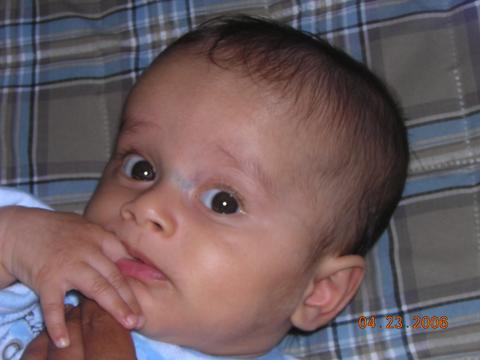
I thought it is just Sidharth, my 5-month old grandson, who gets scared by a whistling pressure cooker, till I read NRIPulse.com. The website for Indian families in the US runs a ‘baby of the fortnight' feature that carries every other week the profile of a child. Parents are invited to mail a set of pix. of their child, along with a note on the baby’s likes, dislikes, and any noticeable skills. Editor (or is it a baby jury) selects one of the entries for web-lication every fortnight.
Photo : Sidharth, in contemplative mode, when the cooker isn't whistling.
Scanning NRIPulse ‘Baby of the Fortnight’ archives I found quite a few parents listing pressure cooker whistle as a scary item. We’re talking about infants from four to 12 months. Why can’t we have a silencer fitted in to kill that noise ? Maybe housewives should represent to the cooker makers. If they can’t kill the shrill, manufacturers could think of modulating it to produce a Himesh Reshamiya number. I hear he is adept in making music (or what passes for it) out of piercing sounds.
May 8, 2006
The Coonoor connection
A nice thing about blogging is it enables connectivity that transcends memory; insofar as it re-connects one-time friends who have long ceased to remember each other. I heard from such a friend, Mr Marshall Gass in New Zealand, the other day, for no reason other than that he happened to Google something I wrote in zine5 some time back – ‘And so I must write to GVK and say Hi’. The zine5 piece had “stirred the tentacles of an old memory”.
Mr Gass used to blog in a Coonoor site I hosted before moving to Mysore. Of the site, Mr Gass, who had left Coonoor over 35 years back, wrote; “So many mates from the old school days have made contact since my e-mail went on this site (Coonoor Connection) – Hindley, Ramamurthy, Francis Mathews, Eates. Amazing. It was the best fun in the world, catching up with those guys I played marbles with 35 years back”.
In his e-mail this Coonoor-connected New Zealander said his memories of the place were ‘browned and faded like an antique photograph’ and described Coonoor as ‘epitaph of a cherubic dream’. “The contacts appeared and disappeared, and once in a while I get the do-you-remember-me story”, writes Mr Gass, “I most often do”.
I write to him saying we have moved on to Mysore, and had to abandon the Coonoor site, now dead out of sheer neglect. But then Mr Gass has a Mysore connection as well. Look up his blog entry in Impressions – ‘Up close and cheeky with Mysore crocs’.
Mr Gass used to blog in a Coonoor site I hosted before moving to Mysore. Of the site, Mr Gass, who had left Coonoor over 35 years back, wrote; “So many mates from the old school days have made contact since my e-mail went on this site (Coonoor Connection) – Hindley, Ramamurthy, Francis Mathews, Eates. Amazing. It was the best fun in the world, catching up with those guys I played marbles with 35 years back”.
In his e-mail this Coonoor-connected New Zealander said his memories of the place were ‘browned and faded like an antique photograph’ and described Coonoor as ‘epitaph of a cherubic dream’. “The contacts appeared and disappeared, and once in a while I get the do-you-remember-me story”, writes Mr Gass, “I most often do”.
I write to him saying we have moved on to Mysore, and had to abandon the Coonoor site, now dead out of sheer neglect. But then Mr Gass has a Mysore connection as well. Look up his blog entry in Impressions – ‘Up close and cheeky with Mysore crocs’.
May 5, 2006
Coping with stray cows in California
San Ramon: A newspaper reader in our neighbourhood paper shares her thoughts on coping with stray cows on hiking trails. For someone from Mysore, where I confront cattle on streets whenever I stir out of house, any advice on tackling cows is of interest. Here is what the Californian cow adviser has to say:
“They (cows) seem to consider us (humans) a threat only if they perceive us to be staring at them. My husband and I have the following conversation while approaching cattle on the trails. We don’t look at them; instead, say to each other ‘I don’t see a cow, do you?’, I say. He says, ‘no, I don’t see any cows either’
“Calm voices seem to help. We’ve walked by cows so close we could have touched them. They don’t run or even move. I think they think we don’t see them. It’s as if they don’t see us, either. I highly recommend this technique”
“They (cows) seem to consider us (humans) a threat only if they perceive us to be staring at them. My husband and I have the following conversation while approaching cattle on the trails. We don’t look at them; instead, say to each other ‘I don’t see a cow, do you?’, I say. He says, ‘no, I don’t see any cows either’
“Calm voices seem to help. We’ve walked by cows so close we could have touched them. They don’t run or even move. I think they think we don’t see them. It’s as if they don’t see us, either. I highly recommend this technique”
April 29, 2006
Putting a Price Tag on War, Quake
San Ramon, Calif.: As someone visiting this country I find aspects of life, an NRI here might dismiss as mundane, so fascinating to be worth writing home about. For instance, the Americans' penchant for putting a price tag on things. Read somewhere they spend $ 200 million a day on Iraq; have spent $ 320 bn till now on the war there; and that the war costs have doubled since the fall of Saddam. The projected combined bill on hostilities in Iraq and Afghanistan is put at $811 bn. And they still have to account for Osama.
I am sure they have a point in keeping count, but it can't have anything to do with strategy to contain war costs or put an end to the seemingly unending war. If cost consideration were a governing factor in global conflicts, no cost-conscious nation would go to war. I suspect that the US of A keeps tab on costs of imponderables such as war and earthquake, only to keep their accountants at full employment level.
My neighborhood paper, ' San Ramon Valley Times', reports that a quake in the Bay Area could set the country back by $ 135 billion to $220 billion, depending on its magnitude. A 6.9 quake would cost $ 135 billion at today's dollar rate. A calamity on 7.3 scale would mean 85 billion more, according to Don Windeler of Risk Management Solutions. He makes it sound as if we have an option, to choose between 7.3 level quake and a less expensive 6.9 quake. Putting a price tag makes sense, to my mind, only if cost is negotiable. Can't ask for a cut-rate quake, can we.
In the 1868 quake, they say, the Bay Area got away with a damage of a mere $300,000. We have Don's word that the next one would be much more costly. Wonder how these risk management guys come up with these intimidating figures, though I can see 'why' they need to do so. Risk management solutions need to factor in the cost of a calamity. Putting a price tag on a disaster makes it grimmer (and, hopefully, helps sell disaster insurance) . Quantifying a quake is the hallmark of an analyst. You and I aren't going to question analyst's figures. If risk management folks say a 6.9 quake would cost $ 135 bn, who am I to differ? And who would print me in newspapers, anyway.
I am sure they have a point in keeping count, but it can't have anything to do with strategy to contain war costs or put an end to the seemingly unending war. If cost consideration were a governing factor in global conflicts, no cost-conscious nation would go to war. I suspect that the US of A keeps tab on costs of imponderables such as war and earthquake, only to keep their accountants at full employment level.
My neighborhood paper, ' San Ramon Valley Times', reports that a quake in the Bay Area could set the country back by $ 135 billion to $220 billion, depending on its magnitude. A 6.9 quake would cost $ 135 billion at today's dollar rate. A calamity on 7.3 scale would mean 85 billion more, according to Don Windeler of Risk Management Solutions. He makes it sound as if we have an option, to choose between 7.3 level quake and a less expensive 6.9 quake. Putting a price tag makes sense, to my mind, only if cost is negotiable. Can't ask for a cut-rate quake, can we.
In the 1868 quake, they say, the Bay Area got away with a damage of a mere $300,000. We have Don's word that the next one would be much more costly. Wonder how these risk management guys come up with these intimidating figures, though I can see 'why' they need to do so. Risk management solutions need to factor in the cost of a calamity. Putting a price tag on a disaster makes it grimmer (and, hopefully, helps sell disaster insurance) . Quantifying a quake is the hallmark of an analyst. You and I aren't going to question analyst's figures. If risk management folks say a 6.9 quake would cost $ 135 bn, who am I to differ? And who would print me in newspapers, anyway.
April 27, 2006
An elephant named Mysore
He provided Sarah, 12, of Bloomington, US, a photo-op. by stepping on a watermelon, crushing it into messy pieces and mouthing them with his trunk. A lesson Sarah, a sixth grader, learnt after a behind-the-scene visit at the circus in town was, 'his table manners are terrible, the elephant's'. Mysore had his trainer Billy Morris spread out on a table apples, grapes and banana. Watermelons were on the floor. Mysore is on the payroll of Barnum & Bailey Circus.
April 24, 2006
‘Desi’ books/CDs in county libraries
San Ramon: At the county library in my neighbourhood, in California, I was pleased/amused to note a placard in vernacular saying, 'Hindi and Gujarati books are available'. Pleased, because it was a matter of pride that our books have found a place in a ‘firangi’ library; and amused by the fact that an overwhelming number of visitors to the library would have no clue to what the placard says. If the idea was to attract the Hindi/Gujarati knowing readers, they needn’t have taken the trouble, for ‘desis’ who use libraries in this part of the world are usually familiar with plain English.
But then the vernacular placard attracted everyone’s attention; it provided a cosmopolitan touch to the setting. County libraries in the US stock foreign language books, video tapes and CDs. Fremont, Calif., library has a shelf full of Hindi and Punjabi film cassettes and CDs. So has the main city library at San Francisco. My wife and I got from Union City county library some movies we couldn’t get to watch back home, in Mysore – classics such as Guru Dutt’s ‘Pyasa’ and some Bimal Roy movies. The library had most episode-wise collection of mega serials, ‘Ramayana’ and Ramanand Sagar’s TV epic ‘Mahabharatha’.
I don’t suppose these video-tapes found their way to the library shelf because the county librarian at Fremont or Union City took a conscious decision and said, ‘Let’s get ‘Ramayana’ or a Gurdass Mann Punjabi movie’. Chances are these video cassettes and books for San Ramon library have been gifted to libraries by benevolent NRIs or local Indian community associations. Wonder if the Indian consulate in San Francisco takes initiative in gifting to US community libraries books and CDs.
The placard at San Ramon library set me thinking, if they can have Hindi and Gujarati, why not books and CDs in Kannada. Imagine Kevempu’s collection or video CD of the movie ‘Beru’ being made available in one’s neibourhood library in the US. Kannada Sanghas could take initiative in mobilizing local residents to donate books. The next time they hold a Kannada literary/cultural conference in the Bay Area, Chicago, New Jersey or wherever, an appeal should be made to the invitee writers and others from India that they would do well to mobilize collection of books and CDs in Karnataka for donation to public libraries in the US or elsewhere in the world.
But then the vernacular placard attracted everyone’s attention; it provided a cosmopolitan touch to the setting. County libraries in the US stock foreign language books, video tapes and CDs. Fremont, Calif., library has a shelf full of Hindi and Punjabi film cassettes and CDs. So has the main city library at San Francisco. My wife and I got from Union City county library some movies we couldn’t get to watch back home, in Mysore – classics such as Guru Dutt’s ‘Pyasa’ and some Bimal Roy movies. The library had most episode-wise collection of mega serials, ‘Ramayana’ and Ramanand Sagar’s TV epic ‘Mahabharatha’.
I don’t suppose these video-tapes found their way to the library shelf because the county librarian at Fremont or Union City took a conscious decision and said, ‘Let’s get ‘Ramayana’ or a Gurdass Mann Punjabi movie’. Chances are these video cassettes and books for San Ramon library have been gifted to libraries by benevolent NRIs or local Indian community associations. Wonder if the Indian consulate in San Francisco takes initiative in gifting to US community libraries books and CDs.
The placard at San Ramon library set me thinking, if they can have Hindi and Gujarati, why not books and CDs in Kannada. Imagine Kevempu’s collection or video CD of the movie ‘Beru’ being made available in one’s neibourhood library in the US. Kannada Sanghas could take initiative in mobilizing local residents to donate books. The next time they hold a Kannada literary/cultural conference in the Bay Area, Chicago, New Jersey or wherever, an appeal should be made to the invitee writers and others from India that they would do well to mobilize collection of books and CDs in Karnataka for donation to public libraries in the US or elsewhere in the world.
April 21, 2006
When Bangalore went berserk
Alexander Zaitchaik, a New Delhi-based journalist, writing in Spiked-online.com about the Raj Kumar fans’ riots, observed that for two days in April Bangalore looked like Baghdad. And, to a bemused world, this fiery convulsion triggered by the death of an old actor was just another example of Indians' idiosyncratic, borderline-religious love for their movie stars…read his story
This is in contrast to the idiosyncrasy captured in a photo of a lady in grief posted by Mr. S R Suresh.
This is in contrast to the idiosyncrasy captured in a photo of a lady in grief posted by Mr. S R Suresh.
April 12, 2006
Disclose yourself, Mr. BOOT; Or else I shall….
Or else, I shall be constrained to name you. When I first spotted odd messages on this site being signed off as ‘Blogging One’s Own Trinkets’ (BOOT) I thought it was a crank call. Spammers usually adopt such call sign that gives no clue to whether it belongs to a she, he or an it. But then, on reading his comments in Capt. Anup Murthy’s blog and mine, I sensed BOOT is no crank. He appears selective, is sensible in what he says, and, to the point; on the ball, as they say.
He gives a bit of himself away when he makes a reference to his blog in one of his comments - http://bloggingtrinkets.blogspot.com/ . But then, you access his blog, you wouldn’t find anyone’s name on it, only his gender and zodiac sign by way of a profile. Bit of a tease, isn’t he? Maybe this is his idea of flogging his blog. Which carries excerpts of essays from a collection, titled – ‘Run of the Mind’. This proves a dead give-away. Come now, Mr Vijendra Rao, your run of anonymity must end here. If anyone cares to read more on Mr Rao’s work, Click on ‘A Mysore newsman’s debut book’.
He gives a bit of himself away when he makes a reference to his blog in one of his comments - http://bloggingtrinkets.blogspot.com/ . But then, you access his blog, you wouldn’t find anyone’s name on it, only his gender and zodiac sign by way of a profile. Bit of a tease, isn’t he? Maybe this is his idea of flogging his blog. Which carries excerpts of essays from a collection, titled – ‘Run of the Mind’. This proves a dead give-away. Come now, Mr Vijendra Rao, your run of anonymity must end here. If anyone cares to read more on Mr Rao’s work, Click on ‘A Mysore newsman’s debut book’.
April 11, 2006
A reader-driven news web initiative
Another web news/views monthly is out on the Net. Its editor, Shivangi Sharma, in an e-mail announcing www.wenewsindia.com says its content would be based on contributions from citizen-journalists. Which is one way of saving money you would otherwise pay staff writers/reporters. A skeleton staff of re-write persons would do. What’s more, WeNews offers to share ad. revenue with contributors. Reader-reporters can have it both ways – have their pieces published on the web and get paid for it as well.
It is an imaginative venture; and can be a win-win one, if it works. I am rather skeptical about a web initiatives in India making money, unless they are about ‘shaadi’/’naukri’. The stories we read about odd bloggers making millions on their spare time obsession with the web are relevant to a San Francisco setting. In our scenario a blog has yet to become a saleable business model. A web-print media synergy is quite another matter.
Another aspect that may not be the best bet to generating ad. revenue, I believe, is ‘WeNews’ periodicity. A monthly update may not be conducive to retaining readership. A month is too long a time to expect readers, who first access the site, to make repeat visits. The widely read weblogs are those that are updated on an on-going basis, even several times during a day.
If WeNews folk have money in mind, they could try a syndicating arrangement with some newspapers for the articles WeNews generate. The web-to-print grassroots journalism is something Shivangi Sharma could work on. The syndication concept has been adopted in Denver, where publishers of The Denver Post bring out a print weekly – YourHub.com – comprising stories from 42 web sites. The Newspapers & Technology website runs a feature on it. To read it click on ‘Grassroots Web Concept’.
It is an imaginative venture; and can be a win-win one, if it works. I am rather skeptical about a web initiatives in India making money, unless they are about ‘shaadi’/’naukri’. The stories we read about odd bloggers making millions on their spare time obsession with the web are relevant to a San Francisco setting. In our scenario a blog has yet to become a saleable business model. A web-print media synergy is quite another matter.
Another aspect that may not be the best bet to generating ad. revenue, I believe, is ‘WeNews’ periodicity. A monthly update may not be conducive to retaining readership. A month is too long a time to expect readers, who first access the site, to make repeat visits. The widely read weblogs are those that are updated on an on-going basis, even several times during a day.
If WeNews folk have money in mind, they could try a syndicating arrangement with some newspapers for the articles WeNews generate. The web-to-print grassroots journalism is something Shivangi Sharma could work on. The syndication concept has been adopted in Denver, where publishers of The Denver Post bring out a print weekly – YourHub.com – comprising stories from 42 web sites. The Newspapers & Technology website runs a feature on it. To read it click on ‘Grassroots Web Concept’.
April 10, 2006
Cremate your worries at a price
San Ramon, CA, Apl.10: Read about this resort at Sedona, Ariz., where they say, you can ‘burn’ your worries. They keep pencils and slips of paper outside the meditation room called Crystal Grotto in Enchantment Resort (ER). You write your worries on a piece of ER issue stationery and drop it in a basket kept at Crystal Grotto. The papers are then consigned to flame, releasing your cares, says NYT travel writer Dwight Garner – ‘I scribbled something about my credit card not being declined and tossed it in’. As media guest Mr.Garner might have done it on the house. Others pay room tariff of $295 night (minimum) for the privilege of burning worries. You do things in style at ER. A bottle of Absolut vodka from room service sets you back by $ 135.
April 7, 2006
‘Churmuri’, not so ‘chutputi’ with comments turned off
I know it’s none of my business, but I wonder why Mr Krishna Prasad appears averse to comments in his blog – ‘Churmuri’. He shuts them firmly with a ‘No comments’ tag on all his postings. My sense of journalists is that they thrive on feedback. For a journalist, the only thing worse than not writing is not being read and commented upon. Besides, interaction is what web culture is all about. Comments make blogs ‘chutputi’. In blogs, they say, it isn’t just comments that are free. Even facts aren’t sacred. Blogs are about perception; about subjective reality that may not tally with facts. But then in a widely accessed blog, where comments are free, you don’t normally get away with blatant untruth without someone taking you on it.
‘Churmuri’, we know, blogs facts and, presumably, has little use for such comments-driven corrective device. And Mr Prasad, I am sure, has his reason for turning off comments. An open forum has its snags. There is no way, short of a turn-off, to prevent people posting spam, promoting their own agenda, crank messages posted by sick minds. We get our share on mymysore.com (look up ‘What's the idea, Elena’) But then we simply can’t do without feedback at MyMysore. Comments are its life-blood.I find ‘Churmuri’ is in the illustrious company of the Washington Post blog, which has shut off comments because, as its exec. editor Jim Brady put it, a significant number of those who posted on the washpost blog had refused to follow the ground rules, which say ‘no personal attack or use of profanity’. Brady articulates his case in ‘Blog Rage’ (click on this to read article).
‘Churmuri’, we know, blogs facts and, presumably, has little use for such comments-driven corrective device. And Mr Prasad, I am sure, has his reason for turning off comments. An open forum has its snags. There is no way, short of a turn-off, to prevent people posting spam, promoting their own agenda, crank messages posted by sick minds. We get our share on mymysore.com (look up ‘What's the idea, Elena’) But then we simply can’t do without feedback at MyMysore. Comments are its life-blood.I find ‘Churmuri’ is in the illustrious company of the Washington Post blog, which has shut off comments because, as its exec. editor Jim Brady put it, a significant number of those who posted on the washpost blog had refused to follow the ground rules, which say ‘no personal attack or use of profanity’. Brady articulates his case in ‘Blog Rage’ (click on this to read article).
April 5, 2006
Dr Sathya Raja in Sierra Leone
I wonder if anyone in the Mysore medical community remembers Sathya, who did medicine in Mysore. I read about his good work with Concern, an international healthcare agency engaged in Sierra Leone that is at the bottom end of the 177 countries on on the UN’s human development index.
To quote a ReliefWeb document, “Indian medical doctor, Sathya Raja is from Bangalore and studied medicine at the University of Mysore in India. He later did post graduate work in community medicine.
Sathya, who works for Concern in Sierra Leone, is convinced that the agency is making a difference for the impoverished people of the country. “I believe passionately this is where we belong and right now we are in a great position to make a difference in health care,” he stresses….Click on to Read More
To quote a ReliefWeb document, “Indian medical doctor, Sathya Raja is from Bangalore and studied medicine at the University of Mysore in India. He later did post graduate work in community medicine.
Sathya, who works for Concern in Sierra Leone, is convinced that the agency is making a difference for the impoverished people of the country. “I believe passionately this is where we belong and right now we are in a great position to make a difference in health care,” he stresses….Click on to Read More
An idea for our print media
San Ramon Valley Times, our neighbourhood daily in California, has put out an appeal to readers - ‘The Times is looking for reader-written dispatches’. The idea is to encourage local residents who are away from home; interested in writing about their experiences; and in sharing them with newspaper readers at home. “It doesn’t have to be all visits to castles and hidden Mayan temples,” says The Times, “sometimes just a visit to a grocery store in an exotic city provides an interesting tale to tell”.
I recall Star of Mysore carried some time back dispatches from Mr Srihari during his stretched out vacation in the US. We could do with more such ‘Letters Home’ from Mysoreans studying/working/visiting abroad. Such features, I am sure, would have a wider appeal, if adopted by the vernacular media. Wonder if ‘Andholana’ would give it a shot?
I recall Star of Mysore carried some time back dispatches from Mr Srihari during his stretched out vacation in the US. We could do with more such ‘Letters Home’ from Mysoreans studying/working/visiting abroad. Such features, I am sure, would have a wider appeal, if adopted by the vernacular media. Wonder if ‘Andholana’ would give it a shot?
March 30, 2006
What’s in a name?
I wish when my grandson Sidharth grows up he shouldn’t work for a call centre in Bangalore, where, I hear, anyone with a perfectly sensible Asian name has it distorted into something popsy and western. I dread the prospects of Sidharth being truncated to ‘Sid’, ‘Sidney’ or ‘Saddy’. I am told the tabloid version of Bollywood actor Madhavan is ‘Maddy’. Founder of the Mysore-based software company SPI is Sid Mookerji, though I suspect they ‘namkaran’-ed him as Sidharth.
My own name got distorted, during s stay in England in the sixties; Krishnan became ‘Kris’. There was this elderly lady who had problem rolling her tongue to say ‘zh’ (for ‘sh’) and so, settled on calling me ‘Kristian’. Mercifully, such mutilation didn’t survive my UK stint. But then, a Wodehouse-mad neighbour of mine in Coonoor insists on addressing me ‘Geeves’.Another Coonoor friend, Ashika, couldn’t figure out why my grandson is named after a hotel. Sidharth is a hotel in Mysore; and she knows of no other Sidharth. Ashika, aged three, goes to pre-school.
My own name got distorted, during s stay in England in the sixties; Krishnan became ‘Kris’. There was this elderly lady who had problem rolling her tongue to say ‘zh’ (for ‘sh’) and so, settled on calling me ‘Kristian’. Mercifully, such mutilation didn’t survive my UK stint. But then, a Wodehouse-mad neighbour of mine in Coonoor insists on addressing me ‘Geeves’.Another Coonoor friend, Ashika, couldn’t figure out why my grandson is named after a hotel. Sidharth is a hotel in Mysore; and she knows of no other Sidharth. Ashika, aged three, goes to pre-school.
March 14, 2006
Making life a little less miserable
My advocate in Chennai, Mr Santhoshkumar, forwarded the following. A lawyer is, perhaps, not a person one would associate with giving you tips on how to make your life less miserable. But then Santhoshkumar has been pursuing my writ plea in the Madras High Court for so long that we became friends. Here, then, is his 10-point programme to better our lives:
1. Throw out nonessential numbers. This includes age, weight and height.Let the doctors worry about them. That is why you pay them.
2. Keep only cheerful friends. The grouches pull you down. (Keep this in mind if you are one of those grouches;)
3. Keep learning: Learn more about the computer, crafts, gardening,whatever. Never let the brain get idle. "An idle mind is the devil's workshop." And the devil's name is Alzheimer's!
4. Enjoy the simple things
5. Laugh often, long and loud. Laugh until you gasp for breath. And if you have a friend who makes you laugh, spend lots and LOTS of time with him/her.
6. The tears happen: Endure, grieve, and move on. The only person who is with us our entire life, is our self. LIVE while you are alive.
7. Surround yourself with what you love: Whether it's family, pets,keepsakes, music, plants, hobbies, whatever. Your home is your refuge.
8. Cherish your health: If it is good, preserve it. If it is unstable,improve it. If it is beyond what you can improve, get help.
9. Don't take guilt trips. Take a trip to the mall, even to the next county, to a foreign country, but NOT to where the guilt is.
10. Tell the people you love that you love them, at every opportunity.
1. Throw out nonessential numbers. This includes age, weight and height.Let the doctors worry about them. That is why you pay them.
2. Keep only cheerful friends. The grouches pull you down. (Keep this in mind if you are one of those grouches;)
3. Keep learning: Learn more about the computer, crafts, gardening,whatever. Never let the brain get idle. "An idle mind is the devil's workshop." And the devil's name is Alzheimer's!
4. Enjoy the simple things
5. Laugh often, long and loud. Laugh until you gasp for breath. And if you have a friend who makes you laugh, spend lots and LOTS of time with him/her.
6. The tears happen: Endure, grieve, and move on. The only person who is with us our entire life, is our self. LIVE while you are alive.
7. Surround yourself with what you love: Whether it's family, pets,keepsakes, music, plants, hobbies, whatever. Your home is your refuge.
8. Cherish your health: If it is good, preserve it. If it is unstable,improve it. If it is beyond what you can improve, get help.
9. Don't take guilt trips. Take a trip to the mall, even to the next county, to a foreign country, but NOT to where the guilt is.
10. Tell the people you love that you love them, at every opportunity.
March 12, 2006
Holi hai
Residents at my block of 60 flats got together at the basement parking lot, Sunday (March 12), to celebrate holi. They invited as chief guest our apartments builder, Mr M B Nagakumar. Which is uncommon, considering that builders/contractors generally do not retain a high reputation among has-been clients. Few apartment owners have zero-complaint against their builder at the end of the day. Builders are not known for delivering whatever they promise, within the timeline they set.
Mr Nagakumar is not Mr Perfect, but he appears to retain a good rapport with his clients. That the residents of Devaraja Mohalla Premier Residency chose to invite him as chief guest at their holi get-together speaks for his reputation. In a way, The Premier Residency holi celebrations made a social statement on builder-client relationship. For the rest the function was marked by the usual fare of song and dance, contest and prizes, and, of course, ‘dandiya’.
Among key players in organizing this ladies-driven 'do' were Ms. Lata Mehta, Anu, Manju, Seema, Hema, Nandiini, Neelam, Priya, Pinky and another Pinky.
Word of advice: Organisers in future would do well to make sure that every child in the block wins a prize. On Sunday Master Nipul Jain was very upset because they didn’t give him a prize. His scream turned into a smile when someone focused her camera on him throwing a tantrum. The photograph was Nipul’s ‘consolation’ prize for the evening
Mr Nagakumar is not Mr Perfect, but he appears to retain a good rapport with his clients. That the residents of Devaraja Mohalla Premier Residency chose to invite him as chief guest at their holi get-together speaks for his reputation. In a way, The Premier Residency holi celebrations made a social statement on builder-client relationship. For the rest the function was marked by the usual fare of song and dance, contest and prizes, and, of course, ‘dandiya’.
Among key players in organizing this ladies-driven 'do' were Ms. Lata Mehta, Anu, Manju, Seema, Hema, Nandiini, Neelam, Priya, Pinky and another Pinky.
Word of advice: Organisers in future would do well to make sure that every child in the block wins a prize. On Sunday Master Nipul Jain was very upset because they didn’t give him a prize. His scream turned into a smile when someone focused her camera on him throwing a tantrum. The photograph was Nipul’s ‘consolation’ prize for the evening
March 5, 2006
A blog is like a shark
If it stops moving, a shark dies. So does a blog, without fresh postings on a daily basis. So says Clive Thompson in a longish New York Magazine piece. (Click ‘Blogs to Riches,if you have the patience to read). A Thompson tip to blogging success is – post wittily, and frequently. It helps if you have a team of post-persons working at it, as they do at Boing, Boing, a top-hit in global blogdom. Boing is steamed by a five-member team, all part-timers. They wouldn’t give up their day jobs, though Boing makes more than enough for them all, by way of ad. revenue. As a Boing blogger and novelist Cory Doctorow put it, “I always figured my life was fueling my blogging, so I didn’t want to be just a blogger’.
Blogging isn’t seen a mainstream occupation by most successful bloggers. Folks are journalists, doctors, aviators, and all of them, bloggers. An arm-chair thumb-twiddler wouldn’t have much to blog about, would he? Everyone on the myMysore blog list leads a full life, which would only enrich the blog. But then many of us need to get our blog going first. Clive Thompson writes of three categories – A-list blogs are an elite few drawing massive readership. B-list blogs are the ones that make a promising start, giving rise to a rising curve of readers. But somewhere along the way the curve flattens off as the blogger fails to sustain enthusiasm. A vast majority of blogs come under the C-list of bloggers who toil in relative obscurity.
I wonder where you would slot mymysore.com and its blogs. My sense is we can’t pigeon-hole many of our bloggers into any of the three accepted categories. They belong to the N-list – blogs that may well die a non-starter. People stop checking out on your blog, after having stared at the blank space under your name, whenever they were there before.
Blogging isn’t seen a mainstream occupation by most successful bloggers. Folks are journalists, doctors, aviators, and all of them, bloggers. An arm-chair thumb-twiddler wouldn’t have much to blog about, would he? Everyone on the myMysore blog list leads a full life, which would only enrich the blog. But then many of us need to get our blog going first. Clive Thompson writes of three categories – A-list blogs are an elite few drawing massive readership. B-list blogs are the ones that make a promising start, giving rise to a rising curve of readers. But somewhere along the way the curve flattens off as the blogger fails to sustain enthusiasm. A vast majority of blogs come under the C-list of bloggers who toil in relative obscurity.
I wonder where you would slot mymysore.com and its blogs. My sense is we can’t pigeon-hole many of our bloggers into any of the three accepted categories. They belong to the N-list – blogs that may well die a non-starter. People stop checking out on your blog, after having stared at the blank space under your name, whenever they were there before.
February 21, 2006
You don't need a reason to love
Heard this on a live-cast of the ‘Art of Living’ mega meet in Bangalore. An overseas visitor, in his all too brief, but meaningful, address had this to say:
My name is Hashim, but it doesn’t matter any more; I’m from Saudi Arabia, and it doesn’t matter any more.
Why am I here? And my answer to it is in two parts. The first part is: “I don’t know”. The second, and more significant, part of the answer is: “I don’t want to know”.
All I know is, you don’t need a reason to be here; to love one another.
My name is Hashim, but it doesn’t matter any more; I’m from Saudi Arabia, and it doesn’t matter any more.
Why am I here? And my answer to it is in two parts. The first part is: “I don’t know”. The second, and more significant, part of the answer is: “I don’t want to know”.
All I know is, you don’t need a reason to be here; to love one another.
Subscribe to:
Posts (Atom)
